10 Van Electrical Mistakes That Cause Fires
By Frank Zale · September 29, 2026 · 5 min read
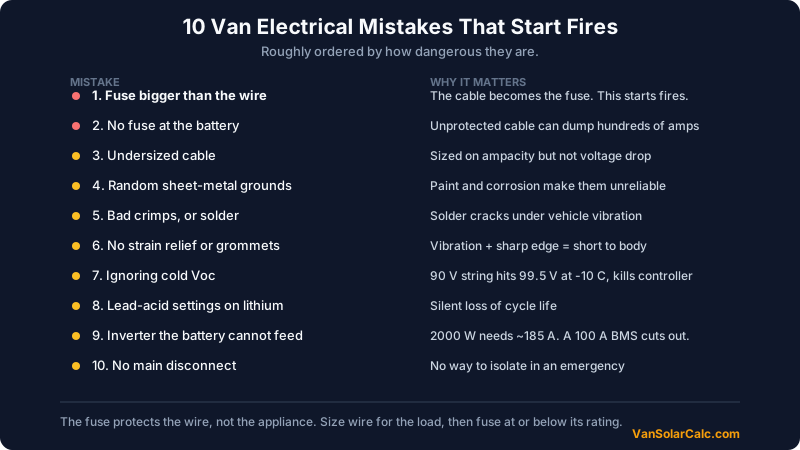
A van electrical system carries house-level current inside a vehicle that vibrates, flexes and gets hot. Mistakes that would be tolerated in a shed become fire risks on the road.
These are the ones that show up repeatedly in DIY builds, in rough order of how dangerous they are.
1. A fuse that is bigger than the wire
This is the most dangerous mistake in the list, and the most common.
The fuse protects the wire, not the appliance. Its job is to fail before the cable overheats. Put a 100 A fuse on wire rated for 40 A and the cable becomes the fuse, which is how vehicle fires start.
Rule: size the wire for the load, then size the fuse at or below the wire's rating. A smaller fuse than the wire is always safe. A larger one never is. See van fuse sizing.
2. No fuse at the battery
Every positive conductor needs protection at its source, within a few inches of the battery terminal.
An unprotected cable between the battery and a distribution point is a short circuit waiting to dump hundreds of amps into whatever it touches. A LiFePO4 bank can deliver enormous fault current, far more than lead-acid, with no warning.
3. Undersized cable
Wire is sized by two constraints: ampacity, meaning how much current it can carry without overheating, and voltage drop over the length of the run.
Van builders usually get the first roughly right and ignore the second. A cable long enough to reach the back of the van can be within its ampacity rating while dropping so much voltage that appliances underperform and the cable runs warm.
Size on the round-trip length, not the one-way distance, and keep drop at or below 3 percent. See wire gauge for solar panels on a van.
4. Using the chassis as a random ground
Steel sheet metal is not a reliable conductor. Paint, seam sealer, and corrosion all sit between the screw and the metal, and vibration works fasteners loose.
Run every negative back to a dedicated negative bus bar, and bond that bus to the chassis at a single, properly prepared point. Scattered sheet-metal grounds cause intermittent faults that are miserable to trace. See grounding a van electrical system.
5. Wrong crimps, or solder where crimps belong
A bad termination is a resistance, and a resistance under load is a heat source.
Use proper ratcheting crimpers and lugs sized to the cable. Do not rely on pliers. Avoid soldering high-current vehicle connections, because solder wicks up the strands and creates a stiff point that fatigues and cracks under vibration.
6. No strain relief or chafe protection
Every point where a cable passes through metal needs a grommet. Every cable run needs securing every foot or so.
Vibration plus a sharp edge equals a cut through insulation and a short to the body, usually somewhere you cannot see.
7. Panels wired without checking cold Voc
Charge controllers are killed by voltage, and panel voltage rises as temperature falls. A four-panel series string that measures 90 V at room temperature can reach nearly 100 V on a freezing morning, exceeding a 100 V controller.
Calculate worst-case cold Voc before choosing your string layout. See solar panel specs explained.
8. Lead-acid charge settings on a lithium battery
Nothing dramatic happens, which is why this persists. Equalisation and temperature compensation are on by default on most controllers and are both wrong for LiFePO4, quietly costing cycle life. See LiFePO4 charge settings.
9. An inverter the battery cannot feed
A 2000 W inverter pulls about 185 A from a 12V bank. A single 100Ah LiFePO4 with a 100 A BMS cannot supply it and will cut out under load.
Match the inverter to the bank's continuous discharge capability, not just to its capacity. See what size inverter do I need.
10. No main disconnect
You need a way to isolate the battery quickly, for maintenance and for emergencies. A properly rated battery switch close to the positive terminal costs little and is the difference between a controlled shutdown and improvising with a spanner.
Getting it right the first time
Most of these come from sizing components in isolation. The cable, fuse, controller and inverter all follow from the same current figures, so calculating them together keeps them consistent. The van solar calculator does this, applying the ABYC ampacity table and a 3 percent voltage drop limit.
FAQ
What is the most common van electrical mistake?
Fitting a fuse rated higher than the wire it protects. The fuse exists to protect the cable, so an oversized fuse leaves the wire as the weakest link, and an overloaded cable overheats rather than the fuse blowing. Always size the wire for the load first, then choose a fuse at or below the wire's rating.
Where should the fuse go in a van electrical system?
As close to the battery as practical, within a few inches of the positive terminal, on every positive conductor leaving the battery. The length of unprotected cable between the battery and the fuse is the part that can short without any protection at all.
Do I need to ground my van electrical system to the chassis?
Yes, but through a single well-prepared bonding point rather than scattered screws into sheet metal. Run all negatives to a dedicated bus bar and bond that bus to bare, clean chassis metal at one location. Paint, sealer and corrosion make random sheet-metal grounds unreliable.
Can I solder van electrical connections?
Not for high-current connections. Solder wicks up the cable strands and creates a rigid section that work-hardens and cracks under constant vehicle vibration. Use correctly sized lugs with a proper ratcheting crimp tool, which is the standard for marine and vehicle wiring.