Can You Live Off Solar in a Van?
By Frank Zale · September 28, 2026 · 4 min read
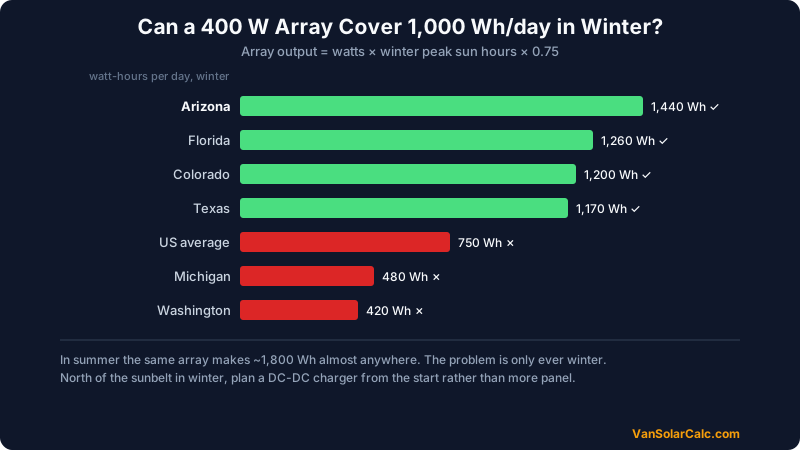
Yes, for most of the year, in most of the country, if your consumption is modest and your roof is clear. No, reliably, year-round, in the northern half of the continent without a second charging source.
Both answers are true, and which one applies to you comes down to three numbers.
The three numbers that decide it
1. Your daily consumption. A build using 800 Wh a day is a very different proposition from one using 2,500 Wh. See how to calculate your van's daily power usage.
2. Your peak sun hours, in winter. Not the annual average. The winter figure is what decides whether solar alone works year-round, and it ranges from 4.9 in New Mexico to 1.4 in Washington. See peak sun hours by state.
3. Your usable roof area. You cannot buy more roof. A Sprinter 144 tops out around 400 to 600 W. See how many solar panels fit on a van roof.
Running the test
The question is whether the array that physically fits generates what you actually use, in the worst month you will be out.
Array output (Wh/day) = array watts × peak sun hours × 0.75
Take a 400 W array, which is realistic for most vans:
| Location | Winter PSH | 400 W output | Covers 1,000 Wh/day? |
|---|---|---|---|
| Arizona | 4.8 | 1,440 Wh | Yes, comfortably |
| Florida | 4.2 | 1,260 Wh | Yes |
| Texas | 3.9 | 1,170 Wh | Yes |
| Colorado | 4.0 | 1,200 Wh | Yes |
| US average | 2.5 | 750 Wh | No |
| Michigan | 1.6 | 480 Wh | Not close |
| Washington | 1.4 | 420 Wh | Not close |
In summer, at the same 400 W and 6 peak sun hours, you get 1,800 Wh a day almost anywhere, which covers most builds easily.
So the honest answer is seasonal and regional. Solar alone is entirely workable if you follow the sun. It is not workable through a northern winter on a van roof, and no reasonable array size changes that.
What "living off solar" actually looks like
In the sunbelt, year-round: genuinely possible. A 400 to 600 W array with 200 to 300Ah of battery covers a normal full-time build in Arizona, New Mexico, Nevada, Texas or Florida with room to spare.
Following the seasons: the most common real answer. Summer in the north, winter in the south, solar carries you the whole time.
Staying north through winter: solar becomes a supplement rather than a source. You will need a DC-DC charger, shore power, or both. This is not a failure of your system, it is arithmetic. See charging while driving.
What makes it work
Cut consumption before adding panels. Reducing daily use by 300 Wh is usually cheaper and easier than adding the 100 W of panel needed to generate it, and it helps every day of the year. See how to reduce power consumption in your van.
Skip electric cooking. An induction hob alone can add 600 to 700 Wh a day. Propane or diesel cooking removes the single largest obstacle to running on solar.
Battery for autonomy, panels for supply. Two to three days of reserve turns a run of cloudy days into an inconvenience rather than a crisis. See what size battery do I need.
Park for the sun. In marginal conditions the parking spot matters more than any component.
The realistic verdict
For a full-time build using 1,000 to 1,500 Wh a day, solar alone works about eight months of the year across most of the US, and year-round in the southwest. For the remaining months in the north, plan a second source from the start rather than discovering the gap in November.
Check your own figures against your real appliance list with the van solar calculator.
FAQ
Can you live off solar power in a van?
Yes in sunny regions and through most of the year elsewhere, provided your consumption is modest. A 400 W array produces about 1,440 Wh a day in an Arizona winter, comfortably covering a typical 1,000 Wh build, but only about 420 Wh a day in a Washington winter, which does not.
How much solar do you need to live in a van full time?
Most full-time builds need 400 to 600 W of panel with 200 to 300Ah of LiFePO4 battery, matched to daily consumption of roughly 1,000 to 1,500 Wh. If you cook electrically, expect to need more of both, or to accept using hookups more often.
Can solar alone power a van in winter?
In the southern US, generally yes. In the northern states, Canada or northern Europe, no. Winter peak sun hours fall as low as 1.4, so even a large van array produces only a few hundred watt-hours a day, less than a fridge uses. A DC-DC charger or shore power is needed for those months.
Do I need a generator if I have solar?
Most van builds do not. A DC-DC charger from the alternator covers the same gap for less money, less weight and no fuel handling, and it works every time you drive. A generator only makes sense if you regularly stay put for long periods in poor sun with high consumption.