What Size Inverter Do I Need for a Van?
By Frank Zale · August 13, 2026 · 6 min read
Most people size a van inverter by adding up everything they own. That produces a 3000 W inverter for a van that needed 1000 W, and it costs you money twice: once at purchase, and again every day in idle draw.
The correct number comes from one question. What is the largest AC load you will run at any single moment?
Size on the largest simultaneous load
An inverter does not care about your daily energy use. That is the battery's job. The inverter only has to survive the worst instant.
If you run a 1000 W kettle, then later a 900 W microwave, but never both together, you need an inverter that handles 1000 W, not 1900 W. If you genuinely run a 1500 W induction hob while a 65 W laptop charges, you need 1565 W of continuous capacity, so a 2000 W unit.
Write down the appliances you will run at the same time, add those watts, and add roughly 20 percent headroom. That is your continuous rating.
Typical van AC loads
| Appliance | Running watts | Notes |
|---|---|---|
| Laptop | 65 W | Often better run on 12V directly |
| TV or monitor | 40 W | Low, rarely the constraint |
| Coffee maker | 800 W | Short run, high draw |
| Microwave | 900 W | Rated output is lower than input draw |
| Instant Pot | 900 W | Long run time, watch the battery |
| Electric kettle | 1000 W | The most common reason for a 1000 W+ inverter |
| Induction cooktop | 1500 W | The single biggest driver of inverter size |
| Hair dryer | 1500 W | Surges high, often trips small inverters |
The pattern is clear. Cooking decides your inverter size. A build with no induction hob, no kettle and no microwave rarely needs more than 600 W.
Surge matters as much as continuous
Motors and compressors draw far more at startup than when running. A fridge compressor, a water pump, a power tool or a hair dryer can pull two to three times its running watts for a fraction of a second.
Inverters quote two numbers: continuous and surge (sometimes "peak"). A 1000 W inverter with 2000 W surge handles a 1500 W startup spike fine. A 1000 W inverter with a weak surge rating will shut down and throw a fault.
If your loads include anything with a motor, check the surge figure, not just the headline rating.
The constraint nobody checks: battery current
This is where most oversized inverters fall apart. An inverter pulls its power from a 12V battery, and the current involved is large.
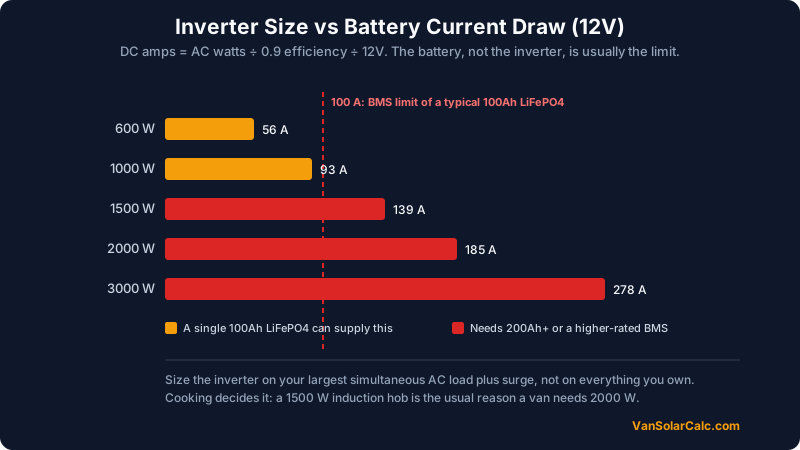
DC amps = AC watts ÷ inverter efficiency ÷ battery volts
At 90 percent efficiency on a 12V system:
| Inverter load | DC current draw |
|---|---|
| 600 W | 56 A |
| 1000 W | 93 A |
| 1500 W | 139 A |
| 2000 W | 185 A |
| 3000 W | 278 A |
Now compare that to your battery. A typical 100Ah LiFePO4 has a BMS rated for 100 A continuous. It physically cannot deliver the 185 A a 2000 W inverter demands. The BMS will cut out, and no amount of inverter capacity changes that.
So the real sizing rule is a pair:
- The inverter must handle your largest simultaneous load plus surge.
- Your battery bank must be able to deliver that load's DC current.
A 2000 W inverter needs roughly 200 Ah of LiFePO4 (or a battery with a 200 A BMS) behind it. A 3000 W inverter on a single 100Ah battery is not a system, it is a fault code.
That current also sets your cable and fuse sizes, which is a safety matter rather than a preference. See how to wire an inverter to a battery safely.
Recommended sizes by build
| Build type | Inverter | Why |
|---|---|---|
| Laptop, phones, camera gear | 300 W | Everything else runs on 12V |
| Occasional blender or small appliance | 600 W | Cheap, low idle draw |
| Kettle or microwave, no induction | 1000–1500 W | Needs 150–200Ah of battery |
| Induction cooking | 2000 W | Needs 200Ah+ and heavy cable |
| Full electric galley, air fryer, hob | 3000 W | Realistically a 24V system |
If your list is pushing past 2000 W, the better move is often to go to 24V rather than buy a bigger 12V inverter. Halving the current halves your cable size and your losses. The distribution side changes too, which is covered in van 12V wiring basics.
Do not forget idle draw
An inverter left switched on consumes power doing nothing. Depending on the model this runs from 5 W to 25 W. At 20 W around the clock that is 480 Wh a day, which is more than many vans use in total.
Bigger inverters generally idle higher. This is the hidden cost of buying more capacity than you need, and it is a good reason to fit a remote switch and turn the thing off between uses.
To check whether your battery bank can actually support the inverter you have in mind, run your appliance list through the van solar calculator. It sizes the battery, cable and fuse to match.
FAQ
What size inverter do I need for a camper van?
Size it on the largest group of AC appliances you will run at the same time, plus about 20 percent headroom. Most vans land between 1000 W and 2000 W. Builds without induction cooking, a kettle or a microwave are usually fine on 600 W, while a full electric galley needs 2000 W or more and a battery bank to match.
Can I run a 2000W inverter on a 100Ah battery?
Not at full load. A 2000 W draw pulls about 185 A from a 12V battery, and a standard 100Ah LiFePO4 has a BMS limited to roughly 100 A continuous, so it will cut out. You can run a 2000 W inverter at partial load, but to use its full rating you need around 200Ah of LiFePO4 or a battery rated for higher continuous discharge.
Is a bigger inverter always better?
No. Larger inverters cost more, need thicker cable and a bigger fuse, and draw more power sitting idle. An oversized unit can waste several hundred watt-hours a day doing nothing. Buy the capacity your largest simultaneous load needs, then spend the difference on battery or panel.
What is the difference between continuous and surge watts?
Continuous is what the inverter can supply indefinitely. Surge, sometimes called peak, is the brief spike it can tolerate for a second or two while a motor or compressor starts. Appliances with motors can draw two to three times their running watts at startup, so an inverter with a weak surge rating will fault out even when its continuous rating looks sufficient.