Van Fuse Sizing: What Size Fuse for Every Circuit
By Frank Zale · September 14, 2026 · 5 min read
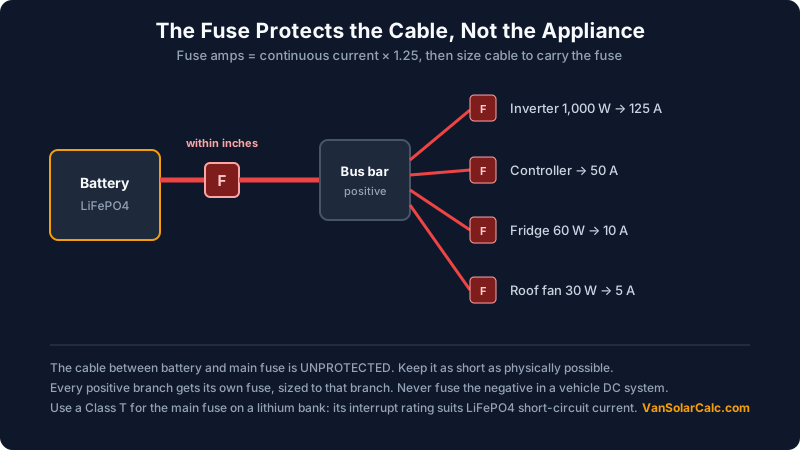
A fuse does not protect your inverter, your fridge or your battery. It protects the cable. Once you understand that, fuse sizing stops being guesswork, because the fuse and the cable are chosen together as a pair.
This is the part of a van build where being casual has real consequences. An unprotected or over-fused cable in a moving vehicle is a fire risk, not an inconvenience.
The rule
Fuse amps = continuous current × 1.25, rounded up to a standard fuse size. Then size the cable to carry the fuse rating.
The order matters. People often size the cable first and then pick a fuse to match, which gets it backwards. The fuse decides the maximum current that can ever flow in that circuit, so the cable must be able to carry the fuse rating indefinitely without overheating.
Continuous current for an inverter is watts divided by system volts divided by 0.9, because inverters are roughly 90% efficient. For DC loads it is simply watts divided by volts.
Worked examples
| Circuit | Continuous current | Fuse | Cable at 5 ft |
|---|---|---|---|
| 1,000 W inverter, 12V | 93 A | 125 A | 4 AWG |
| 2,000 W inverter, 12V | 185 A | 250 A | 1/0 AWG |
| 1,000 W inverter, 24V | 46 A | 60 A | 10 AWG |
| 400 W array to controller, 12V | 33 A | 50 A | 8 AWG |
| 12V compressor fridge, 60 W | 5 A | 10 A | 14 AWG |
| Roof fan, 30 W | 2.5 A | 5 A | 16 AWG |
Note the fridge and fan rows. Small circuits still need fusing. A short in the thin wire feeding a fan will happily start a fire if nothing interrupts it.
Where each fuse goes
Within a few inches of the battery positive terminal. This is the rule that matters most and the one most often broken. The cable between the battery and the fuse is unprotected. If it chafes against the chassis anywhere along its length, the battery delivers hundreds of amps into that fault with nothing to stop it. LiFePO4 banks can deliver enormous short-circuit current.
On every positive run leaving the bus bar. Each branch circuit gets its own fuse sized to that branch, not to the main.
On both sides of the charge controller. The PV input is fused to the controller's rated input, and the controller-to-battery run to its output rating.
Not on the negative side. In a vehicle DC system, fuse the positive conductor only.
Fuse types, and where they belong
| Type | Typical range | Use |
|---|---|---|
| Blade (ATO/ATC/Maxi) | 1 to 80 A | Branch circuits from a fuse block |
| MIDI / AMI | 30 to 200 A | Charge controller, mid-size loads |
| ANL | 35 to 750 A | Battery to inverter, main battery fuse |
| Class T | 100 to 400 A | Lithium banks. High interrupt rating. |
| MRBF | 30 to 300 A | Mounts on the battery terminal itself |
On Class T: with a lithium bank this is the one to use for the main battery fuse. Its interrupt rating is much higher than an ANL, which matters because a LiFePO4 short can produce fault currents that a lower-rated fuse cannot safely break. A fuse that fails to interrupt is worse than no fuse, because it gives false confidence.
On MRBF: terminal-mount fuses are excellent for keeping the protected length as close to zero as possible, which is exactly what you want at the battery.
Common mistakes
Fusing to the appliance instead of the cable. A 30 A fuse on a cable rated for 15 A means the cable can carry 29 A indefinitely without the fuse noticing. The cable is the thing that overheats.
Oversizing "to be safe". A bigger fuse is not safer. It is the opposite: it lets more current flow before interrupting, and the cable is what absorbs that.
Putting the main fuse at the far end of the run. Protecting the cable at the inverter end leaves the whole run between battery and inverter unprotected, which is the section most likely to chafe.
Skipping the fuse on solar input. A charge controller can be back-fed from the battery. Fuse both sides.
Reusing an old fuse block rated below your loads. Check the block's per-circuit and total ratings, not just the fuse values.
Fuse and cable are one decision
Because the cable must carry the fuse rating, changing one changes the other. Longer runs need thicker cable for voltage-drop reasons, which usually leaves ampacity headroom. Shorter runs are often ampacity-limited, where the fuse rating sets the gauge.
Our wire size calculator does both at once, applying ABYC E-11 ampacity and a 3% voltage-drop check and giving you the thicker of the two answers, along with the fuse that belongs with it.
FAQ
What size fuse do I need for a 2000W inverter?
At 12V a 2,000 W inverter draws about 185 A continuously, so the fuse is 185 × 1.25 = 231 A, rounded up to a 250 A fuse. Use a Class T on a lithium bank. The cable must then be rated to carry 250 A, which is 1/0 AWG at short runs and thicker as the distance grows.
How close to the battery does the fuse have to be?
Within a few inches. The cable between the battery terminal and the fuse is unprotected, so that length should be as short as physically possible. A terminal-mount MRBF fuse reduces it to almost nothing.
Can I use a circuit breaker instead of a fuse?
Yes, provided its rating and interrupt capacity suit the circuit. Breakers are convenient because they reset, and they double as a disconnect switch. Check the interrupt rating against your battery's short-circuit current, particularly with lithium.
Do I need a fuse on the negative cable?
No. In a vehicle DC system the negative is bonded to the chassis and you fuse the positive conductor only. Fusing both can leave a circuit energised through the chassis when you believe it is isolated.
Size the fuse and the cable together with the wire size calculator, or work out the whole system at once with the free solar calculator. The full method and its sources are on the methodology page.