Cleaning and Maintaining Van Solar Panels
By Frank Zale · October 2, 2026 · 5 min read
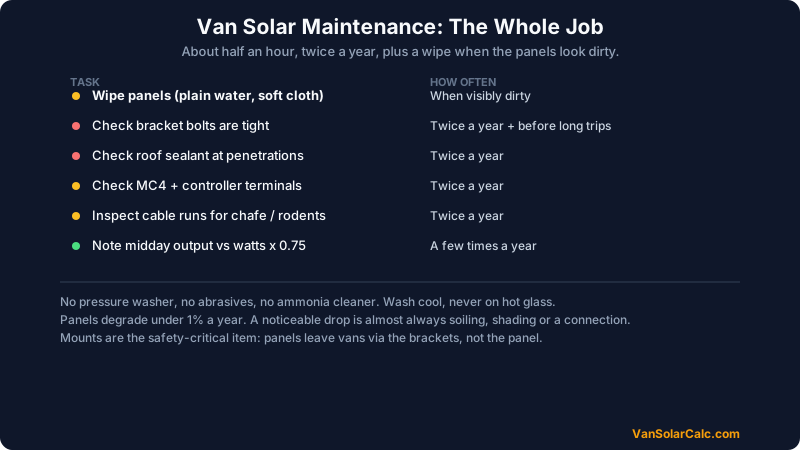
Van solar is close to maintenance free, which is why the small amount it does need gets skipped for years. The result is a system that quietly loses output until someone finally checks and finds it has been running at 80 percent since the second summer.
Here is the whole job. It takes about half an hour, twice a year, plus a wipe when the panels look dirty.
Cleaning the panels
Dirt is shading that never moves. A film of dust, pollen, sap or salt across the whole panel costs a few percent. Bird droppings and tree sap are worse, because a concentrated opaque spot behaves like hard shading and can trigger a bypass diode, taking out a third of the panel.
How to do it:
- Wash in the early morning or evening, never on a hot panel. Cold water on hot glass risks thermal shock.
- Use plain water and a soft cloth or a soft brush. A hose is usually enough.
- For sap or droppings, soak first, then wipe. Do not scrape.
- No abrasives, no pressure washer, no ammonia-based glass cleaner. All three damage the anti-reflective coating.
How often: every couple of months in dusty or pollen-heavy conditions, otherwise when they visibly need it. Rain does a reasonable job on tilted panels and a poor job on flat van roofs, which is one of the small hidden costs of flat mounting.
Checking the mounts
This is the safety-critical part. Panels come off vans at highway speed, and it is always the brackets rather than the panel.
Twice a year, and before any long trip:
- Check every bracket bolt for tightness. Vibration loosens fasteners.
- Inspect adhesive mounts for lifting edges, particularly at the leading edge where wind load is highest.
- Check the sealant around every roof penetration. This is the failure that damages the van rather than the system, since a leak lands in your ceiling.
- Push each panel firmly at its corners. Anything that moves needs attention now.
Mounting methods and their failure modes are covered in how to mount solar panels on a van.
Checking the electrical connections
Vibration is the enemy in a vehicle, and connections are where van systems fail far more often than components.
- MC4 connectors: check they are fully seated and clicked. Look for corrosion or water sitting in a housing.
- Charge controller terminals: nip up the screw terminals. Thermal cycling loosens them.
- Cable runs: look for chafing where cable crosses metal edges, and for rodent damage, which is common when a van sits parked.
- Fuses and busbar connections: check for discolouration or heat marks, which indicate a loose, high-resistance joint.
A connection that is warm under load is a connection about to fail.
Watching the numbers
The most useful maintenance is noticing a decline before it becomes a problem.
On a clear day around midday, note what your controller reports. Compare it against roughly array watts × 0.75 as a rough expectation, so a 400 W array should be delivering somewhere near 300 W in good conditions.
Log it a few times a year. A gradual fall points to soiling or a degrading connection. A sudden drop points to shading, a failed connector or a blown fuse, which is the diagnostic path in solar panels not charging the battery.
Panel degradation itself is slow, typically well under one percent a year on a quality mono panel, so a noticeable drop is almost never the panel.
Winter and storage
- Clear heavy snow gently with a soft brush, never a scraper.
- If the van is stored, keep the battery maintained. A LiFePO4 bank stored at roughly half charge in a cool place is happiest.
- Leaving solar connected during storage keeps the bank topped, provided the controller is configured correctly. See LiFePO4 charge settings and how to winterize your van solar system.
The routine, briefly
| Task | Frequency |
|---|---|
| Wipe panels | When visibly dirty |
| Check bracket bolts and sealant | Twice a year, before long trips |
| Check MC4 and controller terminals | Twice a year |
| Note midday output | A few times a year |
| Inspect cable runs for chafe and rodents | Twice a year |
If your output has fallen and cleaning does not restore it, work through the fault-finding order in how to test a van solar system with a multimeter, and check your expected output against the van solar calculator.
FAQ
How often should I clean van solar panels?
When they look dirty, which in dusty or pollen-heavy conditions means every couple of months. Flat-mounted van panels need cleaning more often than tilted ones because rain runs off less effectively and leaves a film behind rather than washing it away.
Can I pressure wash solar panels?
No. Pressure washing can force water past the seals around the panel edge and damage the anti-reflective coating on the glass. Use a hose, plain water and a soft cloth or brush, and wash when the panels are cool rather than in direct midday sun.
Do solar panels lose efficiency over time?
Yes, but slowly. Quality monocrystalline panels degrade well under one percent a year and are warranted for 25 to 30 years. If your output has dropped noticeably, the cause is almost always soiling, shading or a failing connection rather than the panels themselves.
What maintenance does a van solar system need?
Very little: clean the panels when dirty, check bracket bolts and roof sealant twice a year, check MC4 and controller connections for tightness and corrosion, and note midday output occasionally so you spot a decline early. Connections and mounts need attention far more than panels do, because vehicle vibration works fasteners loose.