LiFePO4 Charge Settings for a Van (Absorption, Float, Time)
By Frank Zale · August 30, 2026 · 5 min read
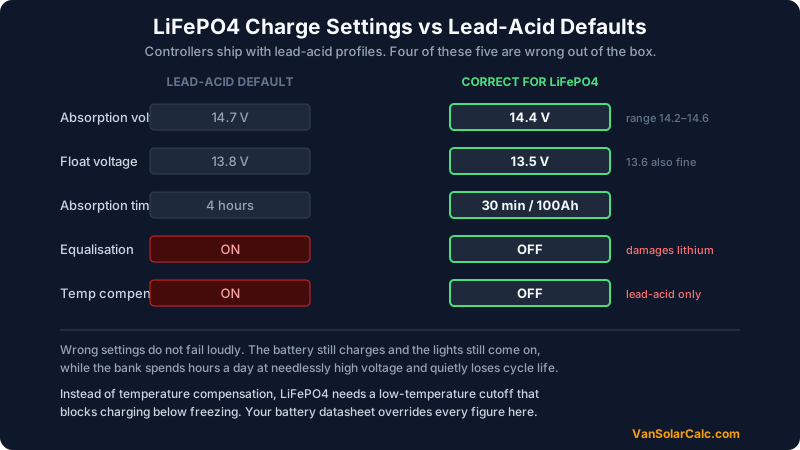
Most charge controllers ship with lead-acid defaults. Connect a LiFePO4 battery without changing them and nothing dramatic happens, which is the problem. The battery charges, the lights come on, and you quietly lose capacity and cycle life for years.
Five settings matter. Four of them are wrong out of the box.
The settings that matter
| Setting | LiFePO4 value | Why |
|---|---|---|
| Absorption voltage | 14.2–14.6 V | Where the bank actually fills |
| Float voltage | 13.5 V | Holds charge without stressing cells |
| Absorption time | ~30 min per 100Ah | Lithium fills fast, then needs to stop |
| Equalisation | Off | Damages lithium. Lead-acid only |
| Temperature compensation | Off | Lead-acid feature, wrong for lithium |
The last two are the ones that cause real harm, and both are enabled by default on controllers configured for lead-acid.
Absorption voltage: 14.2 to 14.6 V
This is the voltage the controller holds while filling the last part of the bank.
14.6 V fills the battery completely. 14.2 V, the Victron lithium default, stops a little short. Both are inside spec and the difference in usable capacity is small, perhaps 2 to 3 percent.
The trade-off is longevity. Sitting at the very top of the voltage range is the most stressful place for a lithium cell. A setting of 14.2 to 14.4 V captures nearly all the capacity while keeping the cells away from that ceiling. For a van bank that gets cycled daily, 14.4 V is a sensible middle.
Your battery manufacturer's datasheet overrides all of this. If it specifies a figure, use that figure.
Float voltage: 13.5 V
Float is what the controller holds after the battery is full.
Lead-acid needs a meaningful float because it self-discharges and sulphates if left partially charged. LiFePO4 does neither. It does not want to be held near full.
13.5 V is the standard recommendation, and 13.6 V is still fine. Above that you are trickling current into a battery that is already full, which is exactly the condition that ages lithium cells fastest. Below 13.4 V and the battery starts supplying the loads instead of the panels, which is harmless but makes state of charge harder to read.
Absorption time: about 30 minutes per 100Ah
Lead-acid controllers often default to hours of absorption because lead-acid genuinely needs it. Lithium does not.
A rough rule is half an hour per 100Ah of capacity. A 200Ah bank needs roughly one hour. Leaving a four hour absorption time set means the bank sits at 14.4 V long after it is full, every sunny day, for the life of the system.
The two settings to switch off
Equalisation. This deliberately overcharges a lead-acid battery to stir the electrolyte and balance cells. Applied to LiFePO4 it is straightforward overvoltage. Some BMS units will disconnect to protect themselves, others will not. Turn it off.
Temperature compensation. Lead-acid needs a higher charge voltage when cold and lower when hot. LiFePO4 does not work this way. Leaving compensation on means the controller raises voltage on a cold morning, pushing an already correct setting too high.
What LiFePO4 needs instead is a low temperature charge cutoff, so no charge is attempted below freezing. Most quality batteries handle this in the BMS. If yours does not, set it in the controller. The reason is covered in charging LiFePO4 in cold weather.
Setting it up
- Read your battery datasheet first. Manufacturer figures win over every general recommendation.
- Set absorption to 14.4 V unless the datasheet says otherwise.
- Set float to 13.5 V.
- Set absorption time to 30 minutes per 100Ah of bank.
- Disable equalisation and temperature compensation. Confirm the low temperature cutoff is handled by the BMS or the controller.
If you are on a PWM controller, these settings matter but you are losing output for a different reason. See MPPT vs PWM.
Getting the controller sized correctly is a separate job from configuring it. That is covered in what size charge controller do I need, and the van solar calculator will size it from your appliance list.
FAQ
What voltage should I charge a LiFePO4 battery to?
Absorption between 14.2 V and 14.6 V for a 12V LiFePO4 bank, with 14.4 V a good default, and float at 13.5 V. Charging to 14.6 V fills the battery completely, while 14.2 to 14.4 V gives up 2 to 3 percent of capacity in exchange for less cell stress and longer life. Always follow your battery manufacturer's datasheet where it differs.
What float voltage should I use for LiFePO4?
13.5 V is the standard figure, and anything up to 13.6 V is acceptable. LiFePO4 does not self-discharge or sulphate like lead-acid, so it does not need a high float. Holding a lithium bank near full voltage continuously is one of the faster ways to age it.
Should temperature compensation be on for lithium batteries?
No. Temperature compensation is a lead-acid feature that raises charge voltage in cold conditions, and LiFePO4 does not need it. Leaving it enabled pushes charge voltage above your intended setting on cold mornings. What lithium needs instead is a low temperature cutoff that blocks charging below freezing.
Can I use lead-acid settings on a LiFePO4 battery?
It will appear to work, which is why the mistake persists. Lead-acid profiles use long absorption times, high float voltages, periodic equalisation and temperature compensation, and all four are wrong for lithium. The result is a bank that spends hours a day at unnecessarily high voltage, losing cycle life without any obvious symptom.