Solar Panels Not Charging Your Battery? Fix It In Order
By Frank Zale · September 24, 2026 · 5 min read
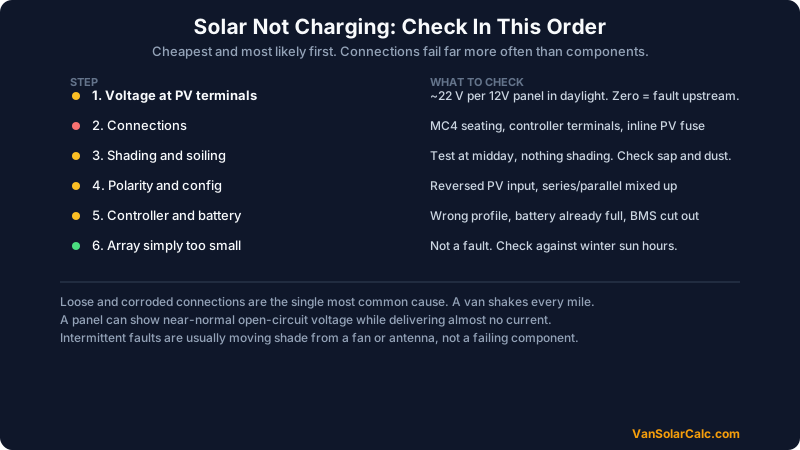
Panels in full sun, controller showing nothing, battery going flat. This is one of the most common van solar faults, and in most cases it is a connection or a configuration problem rather than a dead panel.
Work through it in this order. It goes from most likely and cheapest to check, to least likely.
1. Check the controller is seeing voltage at all
Put a multimeter across the PV input terminals of the charge controller, in daylight.
You should see roughly the open circuit voltage of your array, which is about 22 V for a single 12V panel, or the sum of the panels if they are in series.
- Correct voltage present, but no charging: the problem is downstream. Skip to step 4.
- Zero or near-zero volts: the problem is upstream, in the panels or the wiring between them and the controller. Continue to step 2.
The full method is in how to test a van solar system with a multimeter.
2. Check the connections
Vibration is the enemy in a vehicle. A van shakes every mile, and connections that were fine at the build slowly work loose.
Check in this order:
- MC4 connectors on the roof. They should click firmly. Water sitting in a poorly seated connector corrodes the pin. See MC4 connectors explained.
- The controller's screw terminals. These loosen with vibration and thermal cycling. Nip them up.
- The inline fuse between panels and controller. A blown PV fuse gives exactly this symptom.
- Cable runs through the roof and behind panels. Look for chafing where cable crosses metal, and for rodent damage, which is more common than people expect.
Loose and corroded connections are the single most common cause here.
3. Check for shading, then rule it out properly
Test at midday with genuinely nothing shading the array.
A shadow from a fan housing, an antenna or a roof rack upright can collapse output far out of proportion to its size, because bypass diodes cut out a third of a panel at a time. This often looks like an intermittent fault, since the shadow moves through the day. See solar panel shading on a van.
Also check the panel surface itself. Dust, sap and salt film reduce output across the whole panel.
4. Check the polarity and the wiring configuration
If you have recently rewired, this is the prime suspect.
- Reversed polarity on the PV input. Most quality controllers survive this and simply refuse to charge, which is the symptom you are seeing.
- Series and parallel mixed up. Panels wired in series when the controller expects parallel can exceed its voltage limit, and parallel where you intended series can leave the array below the controller's start-up threshold.
Many MPPT controllers need PV voltage to be roughly 5 V above battery voltage before they will begin. An array that is too low in voltage never starts. The trade-offs are in series vs parallel.
5. Check the controller settings and the battery side
If PV voltage is present and connections are sound, the controller may be working correctly and refusing to charge for a good reason.
- Wrong battery profile. A controller set to a lead-acid profile with a LiFePO4 bank can behave unexpectedly. See LiFePO4 charge settings.
- The battery is already full. A controller in float shows very low current. This is normal, not a fault.
- BMS has disconnected. Below freezing, a LiFePO4 BMS refuses charge entirely, and the controller sees no battery. This is by design. See charging LiFePO4 in cold weather.
- Blown fuse between controller and battery. The controller may not power up at all, since many are powered from the battery side.
6. Consider that the array is simply too small
Not a fault, but worth naming. If the battery never reaches full on a good day, and everything above checks out, the array may be undersized for your loads, particularly in winter.
Check the expected output against your consumption with the van solar calculator, and the seasonal figures in peak sun hours by state.
For faults on the battery side rather than the solar side, see van battery not charging.
FAQ
Why are my solar panels not charging my battery?
Most often a loose or corroded connection, a blown inline fuse, or shading on the array. Start by measuring voltage at the controller's PV terminals in daylight: if you see the array's expected open circuit voltage the fault is downstream in the controller or battery side, and if you see zero the fault is in the panels or their wiring.
How do I know if my solar charge controller is bad?
Controllers fail far less often than connections do, so rule out wiring first. If the PV terminals show correct voltage, the battery is not full, the battery profile is right and the fuses are intact, but the controller still passes no current, then the controller is the likely fault.
Can a solar panel be damaged and still show voltage?
Yes. A panel with a failed bypass diode or a cracked cell can show close to normal open circuit voltage while delivering very little current. Voltage confirms the panel is connected, not that it is healthy, so check current under load rather than voltage alone.
Why do my solar panels work sometimes but not others?
Usually moving shade or an intermittent connection. A shadow from a roof fan or antenna crosses the array at certain hours and collapses output, then clears later. A connector loosened by vibration can also make and break contact as the van moves and heats up.