Solar Panel Shading on a Van: Why One Shadow Kills Your Output
By Frank Zale · August 23, 2026 · 6 min read
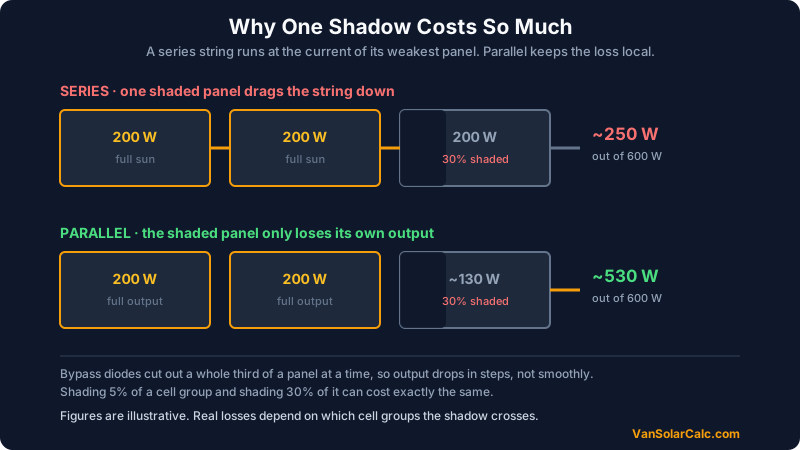
A shadow the width of a broom handle can cost you more than a cloudy afternoon. This surprises people, because it does not match how shade works with anything else. Cover a tenth of a light bulb and you lose a tenth of the light. Cover a tenth of a solar array and you can lose a third of the power, sometimes more.
The reason is that panels are wired in series, and a series circuit runs at the speed of its slowest member.
Why one shadow does so much damage
Inside a panel, cells are connected in series. Current has to pass through every cell in turn, so every cell carries the same current. A cell in shade cannot produce much current, and because it sits in the chain it limits the current of every healthy cell alongside it.
The healthy cells are not broken, they are throttled. They are capable of full output but the shaded cell will not let that current through.
The same logic applies one level up. Panels wired in series form a string, and the string current is set by the weakest panel. Shade one panel in a series pair and both panels drop toward the shaded one's output.
This is why a thin antenna shadow across a corner of one panel can pull down an entire array, and why the fault looks electrical rather than environmental.
Bypass diodes and the rule of thirds
Panel manufacturers know this, so they build in bypass diodes. A typical panel has three, each covering roughly a third of the cells.
When a cell group is shaded enough that its voltage collapses, its bypass diode conducts and current routes around that group instead of being strangled by it. The panel keeps producing, but the bypassed third contributes nothing.
Two practical consequences:
Output falls in steps, not smoothly. Shade a small part of one cell group and you may lose a third of that panel's output at once, because the whole group gets bypassed. This is why a small shadow can cause a large, sudden drop.
A little shade is as bad as a lot. Once a diode has triggered, shading more of that same third costs you nothing extra. Losing 5 percent of the panel area and losing 30 percent of it can produce the same result.
Diodes activate somewhere around 15 to 30 percent shading of a cell group. They also cost a little themselves, since a conducting diode drops roughly 0.7 V.
Series versus parallel under shade
This is the one wiring decision that changes how shade behaves.
| Series string | Parallel | |
|---|---|---|
| Shade on one panel | Drags the whole string down | Loss stays with that panel |
| Wiring | Thinner cable, higher voltage | Thicker cable, higher current |
| Controller start-up | Better in low light | Needs more light to start |
| Best for | Clean, open roofs | Roofs with fans, racks, tree cover |
If your roof has obstructions or you park under trees often, parallel wiring contains the damage. If your roof is clean and you chase open sky, series is the more efficient choice and easier to wire. The full trade-off is in series vs parallel for a camper van.
What actually shades a van roof
Van shade is mostly self-inflicted, and it moves through the day.
- The roof fan. A Maxxair housing stands proud of the roof and throws a shadow that sweeps across nearby panels morning and evening.
- A roof rack or deck. Uprights cast narrow shadows, which are the worst kind, because a thin shadow across several cells triggers a diode just as effectively as a wide one.
- An air conditioner. Tall, wide, and directly upwind of whatever sits behind it.
- Antennas and Starlink. Small footprint, long shadow at low sun angles.
- Trees. Dappled shade is genuinely difficult. Moving parts of the array in and out of shade constantly means the controller is always re-hunting for the maximum power point.
Winter makes all of these worse. The sun sits lower, so every object on the roof throws a longer shadow. A layout that never shades in July can shade for hours in December. Plan the layout against winter sun, not summer. The regional figures are in peak sun hours by state.
What to do about it
Lay out for shadows, not just for area. Keep panels forward of tall roof items where you can. Roof layout constraints by vehicle are covered in how many solar panels fit on a van roof.
Wire around the problem. If one panel is unavoidably shaded at some point every day, put it in parallel rather than in a series string with the others.
Use MPPT, not PWM. An MPPT controller re-finds the optimum operating point as conditions shift, which matters most under partial and moving shade. See MPPT vs PWM.
Park for the panels. On a day you actually need charge, the parking spot is worth more than any hardware decision.
Keep them clean. Dust and sap are low-grade shading across the whole panel, and unlike a shadow they never move.
Once you know your realistic array output, size the rest of the system against it with the van solar calculator.
FAQ
How much does shade affect solar panels?
Far more than the shaded area suggests. Because cells are wired in series, a shaded cell limits current through the whole string, and bypass diodes cut out an entire third of a panel at a time. Shading a small fraction of one panel commonly costs a third of that panel's output, and in a series string it can pull down every panel connected to it.
Do solar panels work in partial shade?
They keep working but at sharply reduced output. Bypass diodes stop a shaded section from blocking the rest of the panel, so you still get power, typically in steps of one third as each cell group drops out. Continuous partial shade over the middle of the day is enough to leave a battery short even on a bright day.
Is series or parallel better for shaded solar panels?
Parallel is better under shade, because each panel feeds the controller independently and a shaded panel only loses its own output. Series is more efficient on a clean roof and starts producing earlier in low light, but one shaded panel drags the whole string down.
Why is my solar output low when the panels look fine?
Partial shading is a common cause and it is easy to miss, since a shadow from a fan or antenna moves through the day and may only cross the array for an hour or two. Other causes are a dirty panel surface, a PWM controller, high panel temperature, or a loose MC4 connection. Check output at midday with no shadow on the array before assuming a fault.