Peak Sun Hours by State: The Number That Decides Your Van Solar Size
By Frank Zale · August 13, 2026 · 9 min read
Most van solar systems are not undersized because someone bought the wrong panel. They are undersized because one number in the math was wrong: peak sun hours.
Peak sun hours (PSH) is the single input that turns your daily power use into an array size. Get it right and a 400 W roof does what you expected. Get it wrong — usually by using a summer figure for a year-round build — and you end up running the engine to charge, or sitting in the dark in November wondering why the panels stopped working.
This guide explains what peak sun hours actually measures, gives you the annual and winter numbers by state, and shows the formula that converts them into panel watts.
What peak sun hours actually means
Peak sun hours are not hours of daylight. This is the mistake behind most bad sizing.
One peak sun hour means one hour of sunlight at 1,000 watts per square metre — the standard test intensity your panel is rated at. Real sunlight is rarely that strong. Early morning and late afternoon sun, low winter sun angles, haze and cloud all deliver less. PSH takes a full day of varying sunlight and compresses it into an equivalent number of full-strength hours.
So a December day in Michigan might have nine hours of daylight and 1.6 peak sun hours. A June day in Arizona might have 14 hours of daylight and 7 peak sun hours. Daylight length tells you almost nothing useful. PSH tells you everything.
The practical result: a 100 W panel does not make 100 W all day. It makes roughly 100 W × PSH watt-hours per day, before losses.
The formula that turns PSH into panel watts
Once you have your daily consumption in watt-hours, the array size is:
Array watts = daily watt-hours ÷ (peak sun hours × 0.75)
The 0.75 is the system factor. It covers the losses between the panel face and the battery: charge controller efficiency, wiring resistance, panel temperature above rating, dust, imperfect angle, and the fact that a flat roof panel never points at the sun. This is the same 0.75 the van solar calculator uses.
Worked example, using a fairly typical build at 1,000 Wh per day:
| Location and season | PSH | Array needed for 1,000 Wh/day |
|---|---|---|
| Arizona, winter | 4.8 | 278 W |
| US national average, annual | 4.5 | 296 W |
| US national average, winter | 2.5 | 533 W |
| Washington, winter | 1.4 | 952 W |
| United Kingdom, winter | 0.8 | 1,667 W |
Same van, same fridge, same laptop. The array that covers it ranges from under 300 W to over 1,600 W depending purely on where and when you park. That spread is why a single "how many watts do I need" answer from a forum is close to useless.
If you have not worked out your daily watt-hours yet, do that first — see how to calculate your van's daily power usage. Everything downstream depends on it.
Peak sun hours by state
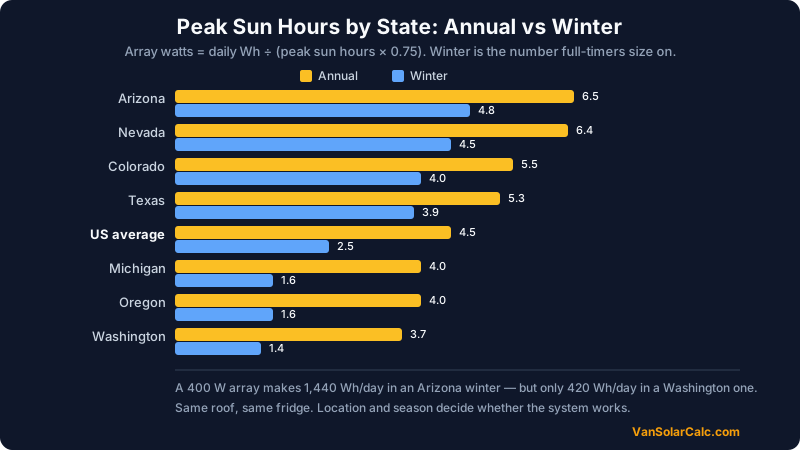
These are the annual and winter figures used by the calculator. The last two columns show what a 400 W array actually delivers per day in each case, at the 0.75 system factor.
| State | Annual PSH | Winter PSH | 400 W array, annual | 400 W array, winter |
|---|---|---|---|---|
| Arizona | 6.5 | 4.8 | 1,950 Wh | 1,440 Wh |
| New Mexico | 6.5 | 4.9 | 1,950 Wh | 1,470 Wh |
| Nevada | 6.4 | 4.5 | 1,920 Wh | 1,350 Wh |
| Colorado | 5.5 | 4.0 | 1,650 Wh | 1,200 Wh |
| Wyoming | 5.5 | 3.4 | 1,650 Wh | 1,020 Wh |
| California | 5.4 | 3.8 | 1,620 Wh | 1,140 Wh |
| Texas | 5.3 | 3.9 | 1,590 Wh | 1,170 Wh |
| Florida | 5.3 | 4.2 | 1,590 Wh | 1,260 Wh |
| Utah | 5.3 | 3.4 | 1,590 Wh | 1,020 Wh |
| Georgia | 5.0 | 3.6 | 1,500 Wh | 1,080 Wh |
| Idaho | 4.9 | 2.4 | 1,470 Wh | 720 Wh |
| North Carolina | 4.7 | 3.3 | 1,410 Wh | 990 Wh |
| Montana | 4.6 | 2.2 | 1,380 Wh | 660 Wh |
| Minnesota | 4.5 | 2.3 | 1,350 Wh | 690 Wh |
| Tennessee | 4.5 | 2.8 | 1,350 Wh | 840 Wh |
| Virginia | 4.5 | 2.9 | 1,350 Wh | 870 Wh |
| US national average | 4.5 | 2.5 | 1,350 Wh | 750 Wh |
| Maine | 4.2 | 2.3 | 1,260 Wh | 690 Wh |
| Michigan | 4.0 | 1.6 | 1,200 Wh | 480 Wh |
| New York | 4.0 | 2.0 | 1,200 Wh | 600 Wh |
| Oregon | 4.0 | 1.6 | 1,200 Wh | 480 Wh |
| Washington | 3.7 | 1.4 | 1,110 Wh | 420 Wh |
One comparison worth sitting with: a 400 W array in Arizona in winter makes 1,440 Wh a day. The same array in Washington makes 1,110 Wh a day averaged over the whole year. Winter in the desert beats the annual average in the Pacific Northwest.
Outside the US
| Country or region | Annual PSH | Winter PSH | 400 W array, winter |
|---|---|---|---|
| Mexico | 5.8 | 4.5 | 1,350 Wh |
| Australia | 5.5 | 4.0 | 1,200 Wh |
| South Africa | 5.5 | 4.5 | 1,350 Wh |
| Spain | 5.0 | 2.8 | 840 Wh |
| New Zealand | 4.4 | 2.3 | 690 Wh |
| Pacific Northwest | 3.8 | 1.5 | 450 Wh |
| Canada | 3.8 | 1.5 | 450 Wh |
| Germany | 3.0 | 1.0 | 300 Wh |
| United Kingdom | 2.5 | 0.8 | 240 Wh |
A 400 W array in the UK in midwinter averages 240 Wh a day. A 12V compressor fridge alone typically uses 500 to 800 Wh a day. That is not a system that needs slightly more panel — it is a system that needs a different charging source.
Which number should you size on?
This is the decision that matters, and it is a travel question, not an electrical one.
Size on the annual figure if you follow good weather, store the van over winter, or travel the southern US in the cold months. Using the winter number here means buying roof space you will never need.
Size on the winter figure if you live in the van year-round in one region, or work from it and cannot afford a flat battery in January. This is the honest number for full-timers.
Size in between if you are seasonal. Many builders use the annual figure for the array and then add a second charging source to cover the gap, which is usually cheaper than the extra panels.
When the winter math stops working
In the northern half of the country, and across most of northern Europe, the winter number produces an array that will not physically fit on a van roof. Nobody is mounting 1,600 W. The answer is not more panels.
- A DC-DC charger. In low-sun months, the alternator becomes the primary source and solar the supplement. Every hour of driving contributes real charge. See charging a van battery while driving.
- More battery, not more panel. Extra capacity lets you bank a sunny day or a hookup night and spend it slowly across the grey ones. Autonomy beats peak output when the peak is never coming.
- Shore power. In deep winter, a few paid campsite nights often cost less than the panels needed to avoid them.
- Tilting brackets. Worth the most exactly where sun is lowest, because a flat panel facing straight up is badly aimed at a low winter sun.
For the regional detail, the location pages break down the seasonal plan for each state and country in the tables above.
Three mistakes to avoid
- Using daylight hours as PSH. Twelve hours of daylight is not twelve peak sun hours. It is often four.
- Sizing on a summer trip. The system that worked beautifully in July is the same system that fails in November. Nothing broke; the sun changed.
- Ignoring the system factor. Rated panel watts × PSH overstates real output by about a third. The 0.75 is not pessimism, it is the wiring, controller, heat and angle you actually have.
Once you have your PSH, run your real appliance list through the solar calculator — it applies these figures automatically and sizes the battery, charge controller, wire and fuses to match.
FAQ
How many peak sun hours do I need for van solar?
You do not choose peak sun hours — your location and season give them to you. What you choose is the array size that works with them. Divide your daily watt-hours by PSH × 0.75. At the US national average of 4.5 annual PSH, a 1,000 Wh/day build needs roughly 300 W of panel; at the 2.5 winter average it needs about 530 W.
Are peak sun hours the same as hours of sunlight?
No. Peak sun hours measure energy, not time. One PSH equals one hour of sunlight at 1,000 W per square metre, the intensity panels are rated at. A winter day can have nine hours of daylight and under two peak sun hours, because low-angle sun is much weaker than test conditions.
What is a good peak sun hour figure for year-round van life?
For full-time year-round use, size on your region's winter figure rather than the annual one. Across the US that winter average is about 2.5 PSH, but it ranges from 4.9 in New Mexico down to 1.4 in Washington. If the winter number produces an array too large for your roof, plan a DC-DC charger and extra battery instead of more panels.
Why does my 400W array make less than 400 watt-hours per hour?
Panels are rated at 1,000 W per square metre, 25 °C cell temperature and perfect alignment, which almost never occurs on a van roof. Real output is the rating multiplied by peak sun hours and then by a system factor of about 0.75 for controller losses, wiring, heat and angle. A 400 W array at 4.5 PSH averages roughly 1,350 Wh a day, not 400 W continuously.