Solar Panels in Series vs Parallel: Which Is Better for a Camper Van?
By Frank Zale · July 14, 2026 · 4 min read
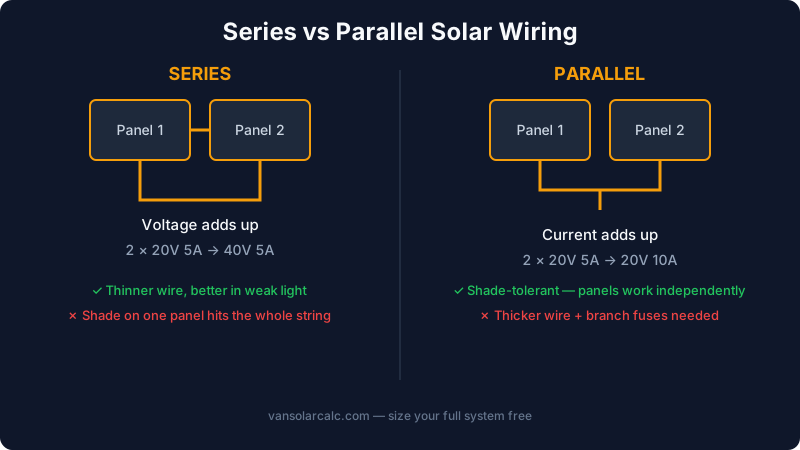
Wire two solar panels in series and the voltage adds up. Wire them in parallel and the current adds up. Same panels, same total watts, but the choice changes your wire size, your charge controller, and how badly shade hurts you. For most camper vans, series wins on efficiency, parallel wins on shade tolerance, and the right answer usually depends on your roof and where you park.
What series and parallel actually mean
Take two identical 100W panels, each rated about 20V and 5A:
| Wiring | Voltage | Current | Total watts |
|---|---|---|---|
| Series | 40V | 5A | 200W |
| Parallel | 20V | 10A | 200W |
Series: positive of one panel connects to the negative of the next, like batteries in a flashlight. Parallel: all positives join together, all negatives join together (using MC4 branch connectors).
The watts are identical. What changes is everything around them.
Why series is usually better on a van
Higher voltage, lower current, and current is what costs you. Wire thickness is set by amps, not volts. A 10A parallel pair needs noticeably thicker wire than a 5A series string over the same run, or you lose power as heat. Our wire gauge guide shows how fast voltage drop eats into thin wire.
MPPT controllers wake up earlier. An MPPT charge controller needs panel voltage comfortably above battery voltage to start charging. A 40V series string clears a 12V battery bank at dawn, in overcast, and in winter sun. A single 20V panel barely clears it when conditions are poor. If you're not sure how MPPT sizing works, see our MPPT charge controller sizing page.
Simpler wiring. Series needs no branch connectors and no per-string fuses at typical van scale. Two fewer parts to buy and two fewer connections to fail.
Why parallel still matters: shade
Here's the catch that keeps parallel alive. In a series string, panels share one current path — shade one panel and the entire string drops toward the shaded panel's output. A vent fan shadow, a roof rack bar, or a tree branch over one panel can cut a series pair by 50–80%.
In parallel, each panel works independently. Shade one and the other keeps producing at full power.
Rule of thumb:
- Clean, open roof, park in the sun → series
- Roof cluttered with fans/racks/boxes, or you park under trees → parallel
- Three or four panels → consider series-parallel (two series pairs in parallel), which splits the difference
Don't forget the controller voltage limit
Series voltages add, and cold weather pushes panel voltage above its rating. Your MPPT controller has a hard maximum input voltage (commonly 75V, 100V, or 150V). Two 40V-Voc panels in series is 80V nominal, and a freezing morning can push that past 90V — instantly fatal to a 75V controller.
Multiply your total series Voc by 1.25 for cold margin and check it against the controller. The calculator applies this margin automatically when it sizes your controller.
Fusing differences
- Series: one string, no combiner fuses needed at van scale; you still fuse the wire from controller to battery.
- Parallel: three or more strings need a fuse on each string, because two healthy strings can backfeed a faulted one.
Either way, the battery-to-inverter cable is the big one — size it with the wire and fuse calculator.
Real-world example: 2 × 200W on a Sprinter
Say you're putting two 200W panels (each ~24V, 8.3A) on a Sprinter 144:
| Series | Parallel | |
|---|---|---|
| Array output | 48V, 8.3A | 24V, 16.6A |
| Wire from roof (5m run) | 12 AWG is fine | 10 AWG or thicker |
| MPPT input | Needs ≥75V rating (cold Voc ~60V+) | 50V rating works |
| Cloudy-morning charging | Starts early | Starts later |
| One panel shaded | Both drop hard | One keeps working |
No roof obstructions? Go series. Fan shadow crossing one panel every afternoon? Parallel earns its thicker wire.
FAQ
Is series or parallel better for solar panels on a van?
Series is better for most vans: thinner wire, earlier charging in weak light, simpler installation. Choose parallel when partial shade is a regular part of your parking or roof layout.
Can I mix panels of different sizes?
In series, mismatched current drags the string to the weakest panel's amps. In parallel, mismatched voltage drags everything to the lowest panel's volts. Match panels within a string; if you must mix, put similar panels in series pairs and parallel the pairs.
Do I need a bigger charge controller for series?
Not bigger — rated for higher input voltage. Controller amp rating is set by your battery-side charging current, which is the same either way. Check both numbers with the MPPT sizing tool.
What about PWM controllers?
PWM controllers can't harvest the extra voltage of a series string — they pull the panel down to battery voltage and waste the difference. If you're wiring in series, use MPPT. Our Victron vs Renogy MPPT comparison covers the popular options.