Lead-Acid to LiFePO4: What Else Must Change
By Frank Zale · September 3, 2026 · 5 min read
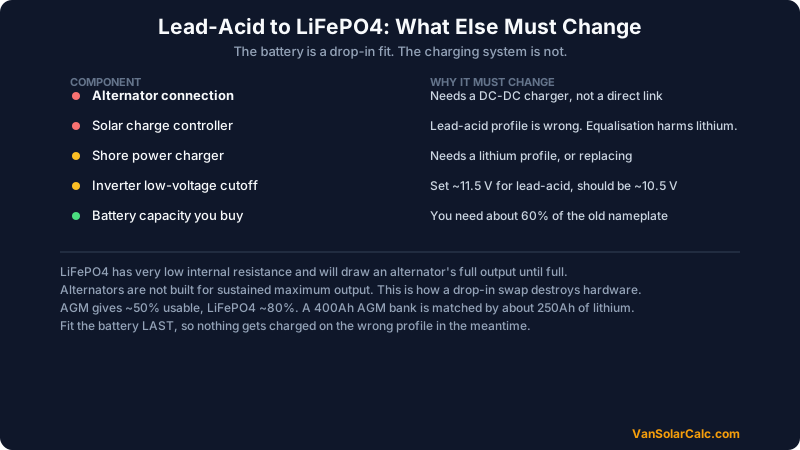
LiFePO4 batteries are sold as drop-in replacements for lead-acid. Physically they are: same box, same terminals, same nominal voltage. Electrically they are not, and the parts of your system that need to change are the parts nobody mentions on the product page.
Swapping the battery alone can cost you the new battery's lifespan, or your alternator.
What actually has to change
| Component | Why it must change |
|---|---|
| Solar charge controller settings | Lead-acid profile is wrong for lithium |
| Shore power charger | Needs a lithium profile, or replacing |
| Alternator connection | Needs a DC-DC charger, not a direct link |
| Inverter low-voltage cutoff | Set for lead-acid, cuts out too early |
| Battery capacity you bought | You need less than you think |
Only the last one is good news.
1. Charge controller settings
Your existing controller almost certainly has a lead-acid profile loaded. That profile uses a high float voltage, a long absorption time, periodic equalisation and temperature compensation.
Equalisation is the dangerous one. It deliberately overcharges a lead-acid battery to balance cells, and applied to lithium it is straightforward overvoltage. Temperature compensation is the subtle one: it raises charge voltage on cold mornings, pushing an already correct setting too high.
Set absorption to 14.4 V, float to 13.5 V, absorption time to about 30 minutes per 100Ah, and switch equalisation and temperature compensation off. Full detail in LiFePO4 charge settings for a van.
2. Your shore power charger
A mains charger built for lead-acid runs the same problematic stages. Desulfation and equalisation modes produce voltage spikes that will trip the BMS into protective shutdown, and repeated shutdowns are not a healthy way to run a battery.
Check whether yours has a selectable lithium profile. Many modern units do. If it does not, replace it. This is the step most often skipped, because the charger appears to work.
3. The alternator connection is the dangerous one
This is where a drop-in swap can destroy hardware rather than just shorten battery life.
Lead-acid has meaningful internal resistance, so it limits how much current it will accept. LiFePO4 has very low internal resistance and will accept everything the alternator can produce, continuously, until it is full.
An alternator is designed for intermittent high output, not sustained maximum. Connected directly to a large lithium bank through a simple relay or split charge system, it can overheat and fail, taking its wiring with it.
You need a DC-DC charger between the alternator and the house bank. It limits current to a figure your alternator can sustain and applies a correct lithium charge profile. See charging a van battery while driving and battery isolator vs DC-DC charger.
If you currently run a voltage-sensitive relay or a simple isolator, that part is being replaced, not reused.
4. Inverter low-voltage cutoff
Inverters have a low-voltage disconnect to protect the battery. Lead-acid settings typically cut out around 11.5 V, because a lead-acid battery at that voltage is genuinely flat.
A LiFePO4 battery still has usable capacity there, and its flat discharge curve means it sits near 12.8 V for most of its range then falls quickly. An inverter set for lead-acid will disconnect while the bank still has energy left, or fail to disconnect early enough on a bank that is genuinely empty.
Set the cutoff to match your battery's specification, commonly around 10.5 V, or configure it from the BMS if your equipment supports that. The voltage curves are in 12V battery voltage chart.
5. Buy less capacity than you had
The one pleasant surprise. Lead-acid gives you about 50 percent usable capacity, LiFePO4 about 80 percent.
A 400Ah AGM bank delivers roughly 200Ah of usable energy. To match that you need about 250Ah of LiFePO4, not 400Ah. People routinely over-buy on a conversion because they match the nameplate figure rather than the usable one.
Work out the number you actually need with what size battery do I need for a camper van, or run your appliances through the van solar calculator.
One thing not to do
Do not run lead-acid and lithium in parallel. Their charge voltages and internal resistances differ enough that the lithium will constantly try to charge the lead-acid, and neither will be charged correctly. It is occasionally suggested as a way to give the alternator somewhere to dump current if the BMS disconnects. That is a real problem, but the correct solution is a DC-DC charger, not mixing chemistries.
Conversion order
- Fit the DC-DC charger, or confirm the alternator is not directly connected.
- Reprogram the solar controller for lithium.
- Confirm or replace the shore charger.
- Adjust the inverter low-voltage cutoff.
- Fit the battery.
Doing the battery last means nothing gets charged incorrectly in the interim.
FAQ
Can I just swap lead-acid for LiFePO4 in my van?
Physically yes, electrically no. The battery will fit and appear to work, but your solar controller, shore charger and inverter cutoff all need reconfiguring for lithium, and the alternator needs a DC-DC charger rather than a direct connection. Skipping those steps shortens the battery's life or risks the alternator.
Will lithium batteries damage my alternator?
They can. LiFePO4 has very low internal resistance and will draw the alternator's full output continuously until charged, and alternators are not built for sustained maximum output. A DC-DC charger limits the current to a level the alternator can safely supply, which is why it is essential rather than optional on a lithium conversion.
Do I need a new charger for LiFePO4?
Only if your existing one has no lithium profile. Lead-acid chargers use desulfation and equalisation stages that produce voltage spikes, which will trigger the BMS to shut down. Many modern chargers have a selectable lithium mode, so check the manual before buying a replacement.
How much LiFePO4 do I need to replace my AGM battery?
Roughly 60 percent of the nameplate capacity. AGM gives about 50 percent usable capacity and LiFePO4 about 80 percent, so a 400Ah AGM bank delivering 200Ah of usable energy is matched by about 250Ah of LiFePO4.