What Size Battery Do I Need for a Camper Van?
By Frank Zale · August 23, 2026 · 6 min read
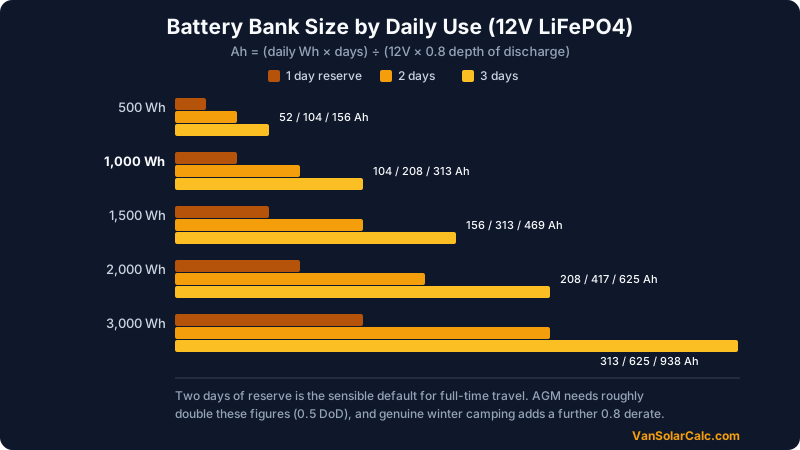
Battery is the most expensive single item in most van builds, and the easiest to get wrong in both directions. Too small and you are hunting for hookups every other day. Too large and you have paid for capacity your panels cannot refill.
The number comes from three inputs: what you use per day, how many days you want to survive without sun, and what chemistry you buy.
The formula
Bank capacity (Ah) = (daily watt-hours × days of autonomy) ÷ (system volts × depth of discharge)
Depth of discharge is the share of the battery you can actually use. LiFePO4 is normally taken as 0.8, AGM as 0.5. That single difference is why a lithium bank half the rated size of a lead-acid bank does the same job.
Worked example. A build using 1,000 Wh a day, wanting two days of reserve, on 12V LiFePO4:
(1,000 × 2) ÷ (12 × 0.8) = 208 Ah
Round up to the nearest real product, so 200Ah or 2 × 100Ah.
If you have not measured your daily watt-hours yet, start there. Everything below is wrong if that number is wrong. See how to calculate your van's daily power usage.
Battery size by daily use
12V LiFePO4 at 0.8 depth of discharge, rounded up to practical sizes.
| Daily use | 1 day reserve | 2 days | 3 days |
|---|---|---|---|
| 500 Wh (weekender) | 52 Ah → 100Ah | 104 Ah → 100Ah | 156 Ah → 200Ah |
| 1,000 Wh (typical) | 104 Ah → 100Ah | 208 Ah → 200Ah | 313 Ah → 300Ah |
| 1,500 Wh (full-time) | 156 Ah → 200Ah | 313 Ah → 300Ah | 469 Ah → 500Ah |
| 2,000 Wh (remote work) | 208 Ah → 200Ah | 417 Ah → 400Ah | 625 Ah → 600Ah |
| 3,000 Wh (heavy electric) | 313 Ah → 300Ah | 625 Ah → 600Ah | 938 Ah → 1000Ah |
Most full-time builds land at 200Ah to 400Ah. If your maths says 600Ah or more, look hard at your loads before spending, because cutting consumption is almost always cheaper than adding lithium.
LiFePO4 versus AGM for the same job
Same 1,000 Wh a day, same two days of reserve:
| Chemistry | Depth of discharge | Bank needed | Practical size |
|---|---|---|---|
| LiFePO4 | 0.8 | 208 Ah | 200Ah |
| AGM | 0.5 | 333 Ah | 350–400Ah |
The AGM bank is roughly twice the capacity, so twice the weight and close to twice the physical volume, to deliver the same usable energy. AGM is cheaper per amp-hour up front and more expensive per usable amp-hour over its life. The full comparison is in van battery types explained.
How many days of reserve do you actually need?
This is the input people guess at, and it moves the answer more than anything else.
One day suits weekend and fair-weather travel where you drive regularly. Any driving day tops the bank back up through a DC-DC charger, so a long run of no charge is unlikely.
Two days is the sensible default for full-time travel. It covers a bad weather day plus the morning after without drama, and it is where most builds settle.
Three or more days is for winter in low-sun regions, dense forest camping, or anyone who cannot afford to lose power for work reasons. Before buying a third day of battery, price a DC-DC charger instead. An hour of driving usually returns more than a winter day of solar.
Reserve is only meaningful if you can refill it. A 400Ah bank behind a 200 W array is a bank that never reaches full. Check the refill time in how long it takes to charge a battery with solar.
The cold weather adjustment
LiFePO4 loses usable capacity in the cold and a BMS will refuse to accept charge below freezing. If you plan to camp in genuine winter, derate the bank by a further 0.8.
That 208 Ah figure becomes 208 ÷ 0.8 = 260 Ah, so 300Ah in practice.
This is a real cost, not a rounding detail, and it is the main reason winter builds look oversized on paper. The mechanism is covered in charging LiFePO4 in cold weather.
Two constraints people forget
Your inverter needs current, not just capacity. A 2000 W inverter pulls about 185 A from a 12V bank, and a typical 100Ah LiFePO4 has a BMS limited near 100 A. The battery can be the right size in watt-hours and still cut out under load. See what size inverter do I need.
Your array has to keep up. As a rough check, a bank should be refillable in about two good days. If it is not, you have bought reserve you cannot use.
Run your actual appliance list through the van solar calculator and it sizes the bank, array, controller, cable and fuse together, which is the only way these constraints stay consistent.
FAQ
What size battery do I need for a camper van?
Multiply your daily watt-hours by the days of reserve you want, then divide by system voltage times depth of discharge (0.8 for LiFePO4, 0.5 for AGM). A typical van using 1,000 Wh a day with two days of reserve needs about 208 Ah at 12V, so a 200Ah LiFePO4 bank. Most full-time builds land between 200Ah and 400Ah.
Is 100Ah enough for a camper van?
For weekend use with a fridge, lights, a fan and phone charging, 100Ah of LiFePO4 covers roughly one day at 500 Wh of consumption. It is not enough for full-time living with a laptop and Starlink, where daily use is usually 1,000 to 1,500 Wh and a single 100Ah battery would be flat before the second evening.
Is it better to have one 200Ah battery or two 100Ah batteries?
Two 100Ah batteries in parallel give you redundancy if one fails, easier handling, and often more BMS current in total, which matters for large inverters. A single 200Ah unit is usually cheaper per amp-hour and has fewer connections to go wrong. For most builds two smaller batteries are the more practical choice.
Can my battery be too big?
Yes. Capacity you cannot recharge is wasted money, and a bank that never reaches full state of charge is worse for lithium longevity than a smaller one that cycles properly. As a rule, if your array cannot refill the bank in about two good days of sun, buy panel before you buy more battery.