12V Battery Voltage Chart: State of Charge Explained
By Frank Zale · September 18, 2026 · 4 min read
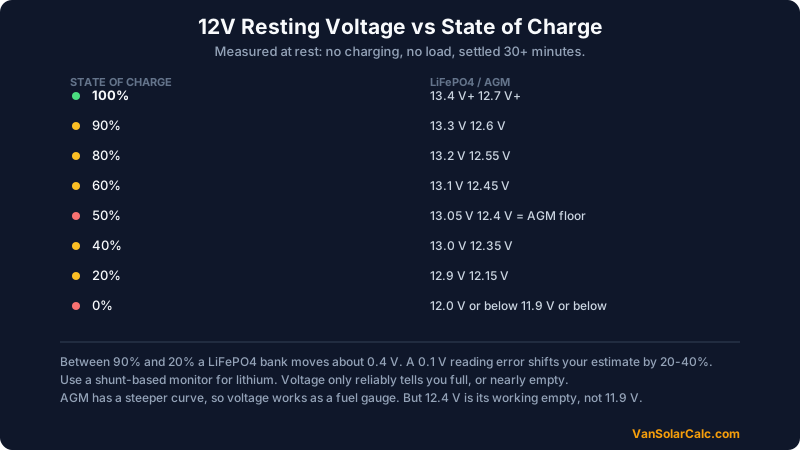
Reading battery voltage is the fastest way to check your state of charge, and for lithium it is also close to useless. Both facts are worth understanding, because the second one catches people who moved from lead-acid to LiFePO4 and kept the old habit.
Here are the charts, and the reason one of them barely works.
12V LiFePO4 voltage chart
These are resting voltages, measured with no charging and no significant load, after the battery has settled for 30 minutes or so.
| State of charge | Resting voltage |
|---|---|
| 100% | 13.4 V+ |
| 90% | 13.3 V |
| 80% | 13.2 V |
| 60% | 13.1 V |
| 40% | 13.0 V |
| 20% | 12.9 V |
| 10% | 12.8 V |
| 0% | 12.0 V or below |
Look at the middle of that table. Between 90 percent and 20 percent full, a 70 percent swing in usable energy, the voltage moves about 0.4 V.
Why the lithium chart barely works
LiFePO4 has a famously flat discharge curve. That is excellent for your appliances, which see a steady voltage almost until the battery is empty, and terrible for guessing state of charge.
A 0.1 V reading error, which is well within the accuracy of a cheap panel meter, moves your estimate by 20 to 40 percent of the battery. Add any load on the bank, or any charging, and the reading shifts further.
The practical conclusion: use a shunt-based battery monitor, not voltage. A shunt counts amp-hours in and out, which is the only accurate way to know where a lithium bank actually sits. See best battery monitor for van life.
Voltage still tells you two useful things on lithium: the battery is full (above 13.4 V resting), or it is nearly empty (below 12.8 V and falling). Between those points, treat it as a rough hint.
12V AGM and lead-acid voltage chart
Lead-acid has a much steeper curve, so voltage genuinely works as a fuel gauge.
| State of charge | Resting voltage |
|---|---|
| 100% | 12.7 V+ |
| 75% | 12.5 V |
| 50% | 12.4 V |
| 25% | 12.2 V |
| 0% | 11.9 V or below |
Note the practical floor. AGM should not be taken below 50 percent regularly, so 12.4 V is your working empty, not 11.9 V. That is why AGM banks need to be roughly twice the size of a lithium bank for the same usable energy, as covered in van battery types explained.
How to take a reading that means something
Three conditions, all of which people skip:
- No charging. Solar, alternator or shore power all raise the reading. Disconnect or wait until after dark.
- No significant load. A running inverter or fridge pulls the voltage down.
- Let it rest. Give the battery at least 30 minutes, ideally a few hours, after charging or heavy use. A battery straight off charge reads high for a while, which is called surface charge.
Measure at the battery terminals, not at a distant socket, or you are reading the voltage drop of your wiring as well.
Voltages that mean something is wrong
- Above 14.6 V while charging on LiFePO4: your charge settings are wrong. See LiFePO4 charge settings.
- Below 12.0 V resting on LiFePO4: the bank is empty or a cell has a problem. Recharge promptly.
- Voltage drops sharply under load then recovers: usually a connection problem or a cable that is too thin, not a dead battery.
- Never reaches full on a sunny day: an array or controller issue rather than a battery one. See van battery not charging.
To size a bank that keeps you comfortably inside these ranges, run your loads through the van solar calculator.
FAQ
What voltage is a 12V LiFePO4 battery when fully charged?
About 13.4 V or higher at rest, measured with no charging and no load after the battery has settled. During charging it will read up to your absorption setting, commonly 14.4 V, which is not a state-of-charge reading.
What voltage is a 12V battery when empty?
For LiFePO4, roughly 12.0 V at rest, though the flat curve means it falls quickly once it reaches that point. For AGM and lead-acid, 11.9 V is fully discharged, but 12.4 V, which is 50 percent, should be treated as your practical floor to avoid shortening the battery's life.
Can I use voltage to check LiFePO4 state of charge?
Only roughly. Between 90 percent and 20 percent charged, a 12V LiFePO4 battery moves only about 0.4 V, so a small measurement error translates into a huge error in estimated charge. Use a shunt-based battery monitor, which counts amp-hours in and out, for anything better than a rough indication.
Why does my battery voltage read higher right after charging?
That is surface charge. Immediately after charging, the voltage at the terminals sits above the battery's true resting voltage and takes time to settle. Wait at least 30 minutes, preferably longer, with no charging and no load before treating a reading as meaningful.