Inverter/Charger Combi vs Separate Units
By Frank Zale · September 3, 2026 · 5 min read
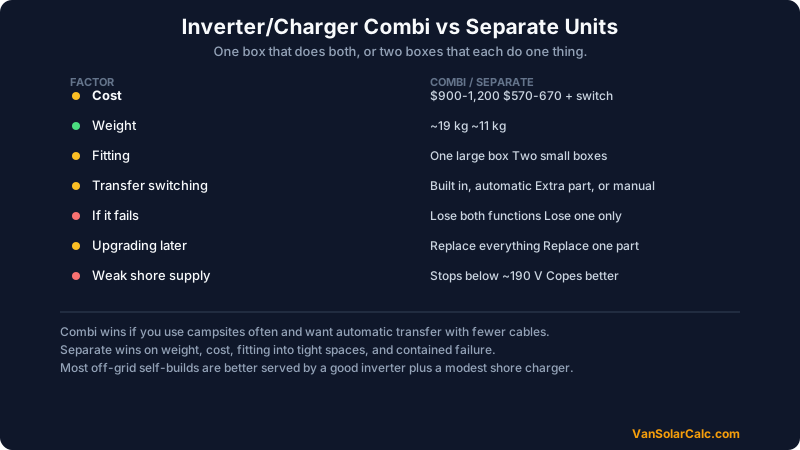
If your van has both an inverter and shore power, you have a choice most builders make by accident: one box that does both, or two boxes that each do one thing.
The combi unit is neater and often cheaper per watt. The separate setup is lighter, easier to fit, and fails in a less annoying way.
What each one is
An inverter/charger (a combi) converts battery DC to mains AC when off-grid, and reverses to charge the battery when plugged in. It contains a transfer switch that swaps between the two automatically, so appliances keep running when you plug in or unplug.
Separate units means a standalone inverter plus a standalone mains charger, with a manual or separate automatic transfer switch between them.
The comparison
| Combi (inverter/charger) | Separate units | |
|---|---|---|
| Typical cost | $900–1,200 | $570–670 plus $50–80 transfer switch |
| Weight | ~19 kg | ~11 kg total |
| Space | One large box | Two smaller boxes, easier to place |
| Transfer switching | Built in, automatic | Extra component, or manual |
| If it fails | You lose both functions | You lose one function |
| Upgrading later | Replace the whole unit | Replace one part |
| Charging efficiency | Shares circuitry, generally efficient | Standalone chargers slightly less so |
The case for a combi
One box, one set of cables. A combi replaces an inverter, a charger and a transfer switch with a single unit and a single set of heavy DC cables. In a van, where every cable run is a hole through something, that matters more than the spec sheet suggests.
Automatic transfer. Plug in at a campsite and your sockets keep working with no switching. Unplug and the inverter takes over. With separate units you either add an automatic transfer switch or you flip something manually every time.
Shared circuitry. Because the same power electronics work in both directions, a combi can charge at higher currents than an equivalently priced standalone charger.
The case for separate units
Weight and fitting. 11 kg against 19 kg, and two smaller boxes fit into van cabinetry far more easily than one large one. This is a genuine constraint in a van, less so in a motorhome.
Failure is contained. If a combi dies you lose inverting and charging at once, which off-grid is a bad day. With separate units, a dead charger still leaves you inverting from solar.
Independent upgrades. Outgrow the inverter and you replace the inverter. With a combi you replace everything.
Tolerance of poor shore power. Combi units are sensitive to grid voltage. Many stop charging below about 190 V, which matters at older campsites with long supply runs. A standalone charger generally copes with a weaker supply.
Cost. Separate is meaningfully cheaper even after adding a transfer switch.
Which to build
Choose a combi if you use shore power regularly, want automatic transfer, have space for one large unit, and prefer fewer components to install and wire.
Choose separate units if you are weight-conscious, tight on space in a way that suits two small boxes, rarely use shore power, or want to contain the cost and the failure modes.
For most self-build vans that spend most nights off-grid, separate units are the pragmatic answer: a good inverter sized to your loads, and a modest shore charger as a backup. For motorhomes and vans that move between campsites regularly, the combi earns its price in convenience.
Size the inverter first
Whichever route you take, the inverter side is sized the same way: on your largest simultaneous AC load plus surge, not on your daily energy use. And the battery has to be able to supply that load's DC current, which is the constraint that catches people out.
See what size inverter do I need, and check the bank can feed it in what size battery do I need. The van solar calculator sizes the inverter, its DC current draw, cable and fuse together.
If you are still deciding whether you need an inverter at all, start with do you need an inverter in a camper van, and for the shore side see shore power for camper vans.
FAQ
Is an inverter/charger better than separate units?
Neither is better outright. A combi saves space and cables and switches automatically between shore power and inverting, which suits vans that use campsites often. Separate units are lighter, cheaper, easier to fit in small spaces, and a failure only takes out one function rather than both.
Do I need an inverter charger for a camper van?
Only if you use shore power. A van that runs entirely on solar and alternator charging needs an inverter but no mains charger at all. Adding a modest standalone shore charger later is inexpensive and does not require replacing the inverter.
What is a transfer switch and do I need one?
A transfer switch decides whether your AC sockets are fed by the inverter or by shore power, and prevents both feeding the circuit at once. Combi units have one built in. With separate components you add one, or accept switching manually each time you plug in.
Are inverter chargers less reliable?
Not inherently, but the consequence of a failure is larger because one unit performs two jobs. Combis are also more sensitive to low shore voltage, with many halting charging below about 190 V, which can be a problem at older campsites with long supply cables.