Is Van Solar Worth It? Cost and Payback
By Frank Zale · September 25, 2026 · 4 min read
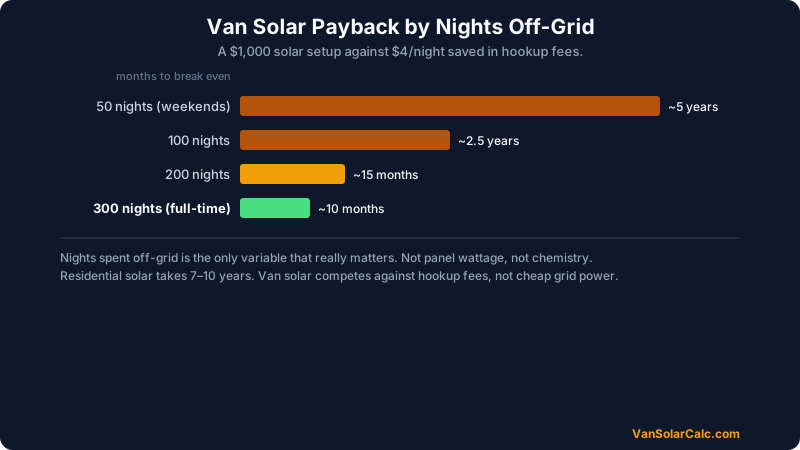
Van solar has a much better return than house solar, and for an unusual reason. A home system competes against grid electricity at roughly 15 cents a kilowatt-hour. A van system competes against campground hookup fees, which are far more expensive per unit of energy.
That changes the maths completely.
The cost side
| Component | Typical cost |
|---|---|
| 400 W panels | $250–400 |
| MPPT charge controller | $100–200 |
| Cable, fuses, connectors, brackets | $150–250 |
| Panels + controller + wiring | $800–1,200 |
| Battery (200Ah LiFePO4) | $600–1,200 |
| Inverter (2000 W) | $250–500 |
| Full electrical system | $1,800–3,000 |
The solar-specific part of a build, meaning panels, controller and wiring, is $800 to $1,200. The battery and inverter are usually counted separately, because you would need a battery whether or not you fitted panels. The full breakdown is in van electrical system cost.
The savings side
Solar replaces paid hookups. A powered campsite typically costs $3 to $5 more per night than the unpowered or dispersed alternative.
| Nights off-grid per year | Annual saving at $4/night |
|---|---|
| 50 (weekends) | $200 |
| 100 | $400 |
| 200 (heavy use) | $800 |
| 300 (full-time) | $1,200 |
Payback
Take the solar portion at $1,000 and divide by the annual saving:
| Use pattern | Annual saving | Payback |
|---|---|---|
| Weekends only (50 nights) | $200 | ~5 years |
| Part-time (100 nights) | $400 | ~2.5 years |
| Heavy use (200 nights) | $800 | ~15 months |
| Full-time (300 nights) | $1,200 | ~10 months |
Compare that with residential solar, which typically takes seven to ten years to break even.
The single variable that decides it is how many nights you actually stay off-grid. Not your panel wattage, not your battery chemistry, not your location. If you mostly stay at powered sites, solar will not pay for itself in any reasonable timeframe.
What the numbers leave out
Payback tables are tidy and real life is not. Three things the arithmetic misses:
Freedom has value the spreadsheet cannot price. Being able to park anywhere for three days is the actual reason most people fit solar, and it does not appear in a dollar figure.
Solar does not cover winter in the north. In low-sun regions a system that pays back in summer contributes almost nothing from November to February, and you will be paying for hookups anyway. See peak sun hours by state.
A DC-DC charger may beat panels on value. If you drive most days, an alternator charger costs less than a solar array and delivers more in poor weather. Many builds get better value from a smaller array plus a DC-DC charger than from a larger array alone. See charging while driving.
When it is not worth it
Be honest about these cases:
- You camp at powered sites most nights. There is nothing to save.
- You store the van over winter and use it a few weekends a year. Payback runs past a decade.
- Your roof is tiny and shaded. A truck camper with 20 sq ft of usable roof under trees will not generate enough to matter. See how many solar panels fit on a van roof.
For everyone else, particularly full-timers, the payback is under two years and often close to one.
To price a system against your own consumption rather than a generic figure, run your appliances through the van solar calculator, which includes a cost estimate.
FAQ
Is solar worth it for a camper van?
For full-time and heavy part-time travel, yes. A $800 to $1,200 solar setup saves $3 to $5 a night in hookup fees, so at 200 or more nights off-grid a year it pays for itself in 10 to 15 months. For occasional weekend use at powered campsites, payback stretches past five years and the case is much weaker.
How much does van solar cost?
Panels, an MPPT controller and wiring for a typical 400 W van array cost $800 to $1,200. A complete electrical system including a 200Ah LiFePO4 battery and a 2000 W inverter runs $1,800 to $3,000, though the battery and inverter are needed regardless of whether you fit solar.
How long does it take for van solar to pay for itself?
Roughly 10 to 15 months for full-time travellers staying off-grid 200 to 300 nights a year, and about 2.5 years at 100 nights. The deciding factor is nights spent off-grid rather than system size, since the saving comes entirely from avoided hookup fees.
Is van solar better value than house solar?
The payback is far quicker. Residential solar competes against grid power at around 15 cents per kilowatt-hour and typically takes seven to ten years to break even. Van solar competes against campground hookup fees, which are much more expensive per unit of energy, so it commonly breaks even inside two years.