How Many Solar Panels Fit on a Van Roof?
By Frank Zale · August 13, 2026 · 6 min read
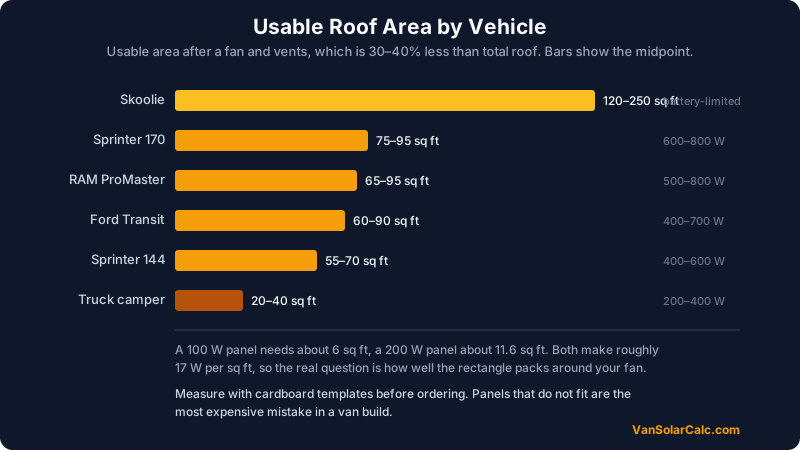
Roof space is the hard limit on van solar. You can always buy a bigger battery or a better controller, but you cannot buy more roof. Working out how much panel actually fits, before you order anything, saves the most expensive mistake in a van build: panels that arrive and do not go on.
The short version is that usable roof is far smaller than total roof, and the gap is typically 30 to 40 percent.
Panel sizes you are actually working with
Panel wattage does not tell you size directly, but the common van options cluster into three groups.
| Panel | Rough dimensions | Area | Watts per sq ft |
|---|---|---|---|
| 100 W rigid | 41 x 21 in | 6.0 sq ft | 17 W |
| 200 W rigid | 62 x 27 in | 11.6 sq ft | 17 W |
| 400 W residential | 79 x 44 in | 24.1 sq ft | 17 W |
Note the last column. Panel efficiency per square foot is roughly the same across sizes, around 17 to 19 W per sq ft for mono panels. So the question is not which wattage is most efficient, it is how well a given rectangle packs into the space you have left.
Larger panels win on cost and on wiring: fewer brackets, fewer roof penetrations, fewer MC4 connections to fail. Smaller panels win on packing around obstacles. On most vans the answer is two large panels rather than four small ones, unless a fan sits awkwardly.
How much roof each van actually has
These are the usable figures used by the calculator, after allowing for a fan and vents.
| Vehicle | Usable roof | Realistic array |
|---|---|---|
| Mercedes Sprinter 144 | 55–70 sq ft | 400–600 W |
| Mercedes Sprinter 170 | 75–95 sq ft | 600–800 W |
| Ford Transit | 60–90 sq ft | 400–700 W |
| RAM ProMaster | 65–95 sq ft | 500–800 W |
| Skoolie | 120–250 sq ft | Battery and budget limit you, not roof |
| Truck camper | 20–40 sq ft | 200–400 W |
The ProMaster is worth calling out. It has the widest roof in the class, which means a 200 W panel often sits crosswise where it would not fit on a Sprinter. Width matters more than length for packing, because most roofs are longer than anything you will mount.
What eats your roof
Total roof area is not available area. The things that take it:
A roof fan. A Maxxair or Fantastic Fan takes a 14 x 14 inch square, about 1.4 sq ft of hole, but it costs far more than that in practice because it splits the roof into sections. A fan in the middle of a Sprinter 144 turns one long run into two shorter ones, and a 62 inch panel may not fit either.
A second vent or hatch. Common over the galley, and it fragments the remaining space the same way.
A roof rack or deck. Takes area and casts shadows.
Air conditioning. A rooftop AC unit is the single biggest consumer of roof, and on a truck camper it can halve your available space.
Edge clearance. You need a few inches from the roof edge for brackets and for the curvature of the roof panel itself. Vans are not flat on top.
The practical method: get on the roof with a tape measure and cardboard templates cut to your panel dimensions. Move them around before you buy. This takes twenty minutes and it is the only way to know.
Shading is a layout problem
Where you put panels matters as much as how many fit.
A fan housing, an antenna or a rack upright throws a shadow that moves through the day and lengthens in winter. A shadow across one panel in a series string pulls down the whole string, not just the shaded panel. This is why panels behind a tall obstruction underperform in ways that look like a fault.
Two practical rules. Keep panels forward of tall roof items where you can, and if you cannot, wire the shaded panel in parallel rather than series so its losses stay local. The trade-offs are covered in series vs parallel wiring.
When the roof is not enough
If the array that fits is smaller than the array you need, you have three options and more panel is not one of them.
- A DC-DC charger. Turns driving time into charge. See charging while driving.
- A portable panel on a lead. Lets you park in shade and put the panel in sun, which is often worth more than another rooftop panel.
- Cut the load. A more efficient fridge or moving loads off the inverter often closes the gap for less money than any charging hardware.
Work out the array you need first, then check it against the roof you have. The van solar calculator sizes the array from your real appliance list, and how much solar does an RV need covers the larger vehicles.
FAQ
How many solar panels can fit on a Sprinter van?
A Sprinter 144 has roughly 55 to 70 sq ft of usable roof after a fan and vents, which fits two 200 W panels or three to four 100 W panels, so 400 to 600 W in practice. The longer 170 wheelbase offers 75 to 95 sq ft and comfortably takes 600 to 800 W without crowding the vents.
How much roof space does a 100W solar panel need?
A typical 100 W rigid panel measures about 41 by 21 inches, so roughly 6 sq ft, plus a couple of inches around the edge for brackets. A 200 W panel is about 62 by 27 inches, or 11.6 sq ft. Allow slightly more than the raw panel area for mounting hardware and cable runs.
Are bigger solar panels better for a van?
Per square foot they produce about the same, around 17 to 19 W, so the choice is practical rather than electrical. Larger panels mean fewer brackets, fewer roof penetrations and fewer connections to fail, which is why most builds use two large panels. Smaller panels only win when you need to work around a fan or vent that breaks up the roof.
Can I put solar panels over a roof vent or fan?
No, a fan needs clearance to open and must stay unobstructed. Plan the panel layout around the fan rather than the other way round, and keep panels forward of it where possible so the housing does not shade them in low winter sun.