12V Fridge Power Consumption: Amps and Daily Use
By Frank Zale · September 21, 2026 · 4 min read
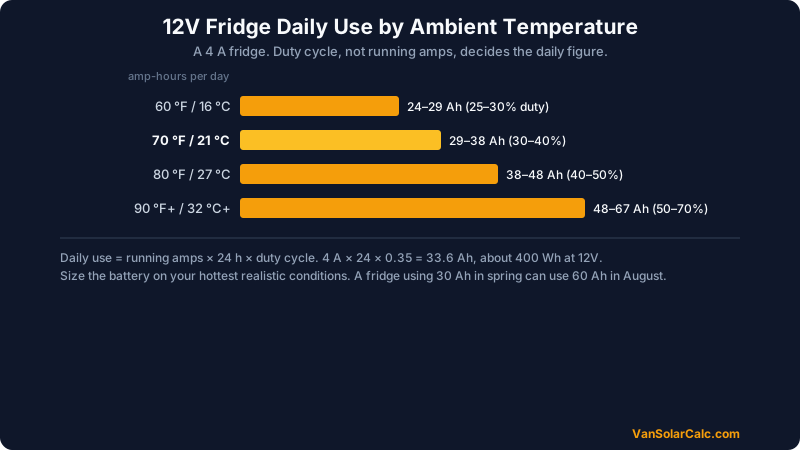
Fridge is the single biggest load in almost every van, and it is the one people size worst. The confusion comes from a simple mistake: reading the compressor's running amps and assuming it draws that all day.
It does not. The compressor cycles, and the duty cycle is what actually decides your daily figure.
Running amps versus daily consumption
A 12V compressor fridge draws roughly 2 to 6 amps while the compressor is running, with most van-sized units around 4 A.
But the compressor only runs part of the time. The rest of the hour it is off, drawing almost nothing.
Daily use (Ah) = running amps × 24 hours × duty cycle
At 4 A with a 35 percent duty cycle:
4 × 24 × 0.35 = 33.6 Ah per day, which is about 400 Wh at 12V.
That is the number to build your system on. The 4 A figure on the spec sheet is not.
Duty cycle by temperature
Duty cycle is not a fixed property of the fridge. It is mostly a function of how hard the fridge is fighting the ambient temperature.
| Ambient | Duty cycle | Daily use (4 A fridge) |
|---|---|---|
| 60 °F / 16 °C | 25–30% | 24–29 Ah |
| 70 °F / 21 °C | 30–40% | 29–38 Ah |
| 80 °F / 27 °C | 40–50% | 38–48 Ah |
| 90 °F+ / 32 °C+ | 50–70% | 48–67 Ah |
A fridge that uses 30 Ah a day in spring can use 60 Ah in an Arizona August. If you size your battery on the spring figure, the system fails in exactly the conditions where you most want cold food.
Design on your hottest realistic conditions, not the average.
The realistic planning range
For a typical van fridge, plan on 30 to 50 Ah per day, or roughly 360 to 600 Wh.
That single appliance is often a third to a half of a van's entire daily consumption. It is also the load that runs whether you are in the van or not, which is why it dominates the battery sizing calculation. See how to calculate your van's daily power usage.
What actually changes the number
Ambient temperature. The dominant factor, as above.
Insulation around the fridge. A fridge boxed into cabinetry with no airflow around the condenser runs far longer to reach the same temperature. Leave ventilation gaps and, if the unit is enclosed, add a vent.
Thermostat setting. Every degree colder costs runtime. A fridge set to 3 °C instead of 5 °C works noticeably harder for no practical benefit.
How often you open it. Each opening dumps the cold air out. A drawer-style or top-opening fridge holds cold better than a front-opening door, because cold air does not fall out when you open it.
Freezer use. Running a combined unit as a freezer roughly doubles consumption.
Sun on the van. Parking in shade lowers cabin temperature, which lowers fridge duty cycle. This is a free saving.
Sizing the system around it
Once you have a realistic daily figure, the rest follows. A fridge at 40 Ah a day is 480 Wh, which on its own needs roughly 145 W of array at the US average of 4.5 peak sun hours, before you add anything else.
Run your full appliance list through the van solar calculator to size the array and battery together, and see what size battery do I need for a camper van for the bank.
If you are still choosing between fridge types, the running-cost comparison is in 12V compressor vs propane fridge, and the circuit itself is covered in wiring a 12V fridge in a van.
FAQ
How many amps does a 12V fridge use?
Around 2 to 6 amps while the compressor is running, with most van fridges near 4 A. The figure that matters is daily consumption, which accounts for the compressor cycling on and off. At a 35 percent duty cycle a 4 A fridge uses about 34 Ah a day, or roughly 400 Wh.
How much power does a camper fridge use per day?
Plan on 30 to 50 Ah per day at 12V, which is about 360 to 600 Wh. The exact figure depends mostly on ambient temperature: expect the low end in mild spring weather and the high end, sometimes more, in summer heat above 90 °F.
Can a 100Ah battery run a 12V fridge?
Yes, but not for long on its own. A 100Ah LiFePO4 battery gives about 80 Ah of usable capacity, so a fridge using 40 Ah a day would flatten it in roughly two days with nothing else running. In practice the fridge shares the bank with lights, a fan and devices, so it needs daily recharging from solar or an alternator.
Why does my fridge use more power in summer?
Because duty cycle rises with ambient temperature. In mild conditions the compressor runs 30 to 40 percent of the time, but above 90 °F it can run 50 to 70 percent of the time to hold the same internal temperature. The fridge has not changed, it is simply working against a larger temperature difference.