How Long Does It Take to Charge a Van Battery With Solar?
By Frank Zale · August 13, 2026 · 6 min read
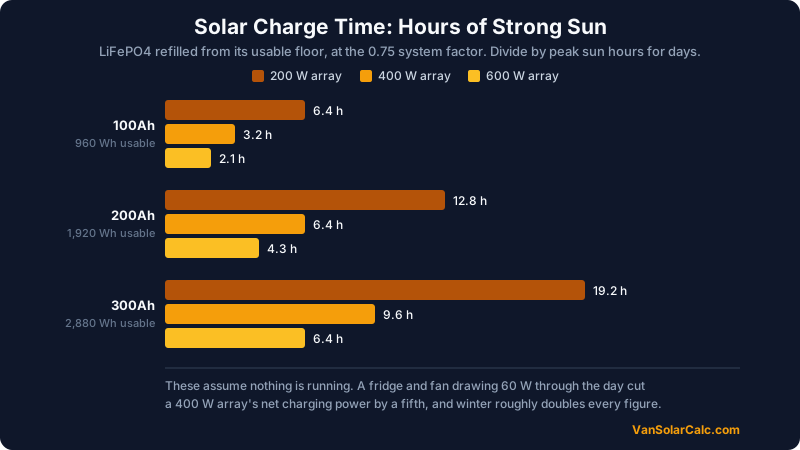
"How long will it take to fill my battery?" is one of the most common questions in van solar, and most answers online are wrong in the same way. They divide battery capacity by panel wattage and call it done. That gives you a number roughly half the time it actually takes.
Here is the honest version, with the losses included and a table you can read straight off.
The short answer
For a 100Ah LiFePO4 battery drawn down to its usable limit, recharging from solar takes roughly:
- 200 W of panel: about 6.4 hours of strong sun, so 1.5 days of typical sun
- 400 W of panel: about 3.2 hours of strong sun, so under one day
- 600 W of panel: about 2.1 hours of strong sun, so half a day
Those are best-case figures with nothing else running. Keep reading for why that matters more than the numbers do.
The formula
Two steps. First, work out how much energy you actually need to put back:
Energy needed (Wh) = battery amp-hours × battery volts × depth of discharge
A 100Ah battery at 12V holds 1,200 Wh on paper. You never use all of it. LiFePO4 gives you about 80 percent, so 960 Wh. AGM gives you about 50 percent, so 600 Wh.
Second, work out what your array actually delivers:
Real charging power (W) = array watts × 0.75
The 0.75 covers charge controller losses, wiring resistance, panel heat, dust and imperfect angle. A 400 W array delivers about 300 W to the battery in good sun, not 400 W.
Divide one by the other:
Charge time (hours of strong sun) = energy needed ÷ real charging power
Solar charge time table
Hours of strong sun needed to refill a LiFePO4 battery from its usable floor, at the 0.75 system factor.
| Battery | Usable energy | 200 W array | 400 W array | 600 W array |
|---|---|---|---|---|
| 100Ah LiFePO4 | 960 Wh | 6.4 h | 3.2 h | 2.1 h |
| 200Ah LiFePO4 | 1,920 Wh | 12.8 h | 6.4 h | 4.3 h |
| 300Ah LiFePO4 | 2,880 Wh | 19.2 h | 9.6 h | 6.4 h |
Those are hours of full-strength sun, not hours of daylight. To convert to days, divide by your local peak sun hours. At the US national average of 4.5:
| Battery | 200 W array | 400 W array | 600 W array |
|---|---|---|---|
| 100Ah | 1.4 days | 0.7 days | 0.5 days |
| 200Ah | 2.8 days | 1.4 days | 0.9 days |
| 300Ah | 4.3 days | 2.1 days | 1.4 days |
If you are not sure what your peak sun hours are, the peak sun hours by state table has the annual and winter figures. Winter roughly doubles every number above.
Why the table is optimistic
Three things make real charging slower, and the third catches almost everyone.
The absorption stage. Batteries do not accept full current all the way to 100 percent. LiFePO4 takes near-full current to about 95 percent and then tapers, which is mild. AGM tapers far earlier and can spend three or four hours crawling through the last 20 percent. For AGM, add several hours to any figure above.
Cold. Panel output holds up in the cold, but battery acceptance drops, and below freezing a LiFePO4 BMS will refuse charge entirely. See charging LiFePO4 in cold weather.
Your fridge is still running. This is the big one. The table assumes every watt goes into the battery. In reality your fridge, fan, and laptop are drawing the whole time the sun is up. If your loads average 60 W during daylight, a 400 W array is not putting 300 W into the battery, it is putting 240 W in. That stretches a 3.2 hour charge to 4 hours, and on a cloudy day it can mean the battery never fills at all.
The practical rule: net charging power is your real array output minus whatever you are running at the time.
What actually speeds it up
More panel, not more battery. Extra capacity gives you more reserve, but it does not charge faster. If your battery routinely fails to reach full, the array is the constraint.
An MPPT controller. A PWM controller wastes a meaningful share of panel output, particularly in cold or when panel voltage sits well above battery voltage. See MPPT vs PWM.
A DC-DC charger. An hour of driving often puts back more than half a day of winter sun. For anyone travelling in the colder months this is the fastest practical way to refill a bank.
Shade discipline. A single shaded panel in a series string drags the whole string down. Park for the panels, not the shade, on days you need the charge.
To size all of this against your real appliance list rather than a generic 100Ah figure, run it through the van solar calculator.
FAQ
How long does it take to charge a 100Ah battery with a 200W solar panel?
About 6.4 hours of strong sun for a LiFePO4 battery refilled from its usable floor, which works out to roughly a day and a half at average US sun levels. A 100Ah LiFePO4 holds 1,200 Wh but only about 960 Wh is usable, and a 200 W array delivers roughly 150 W after system losses.
Can a 100W solar panel charge a 100Ah battery?
Yes, but slowly. A 100 W panel delivers about 75 W in good sun, so refilling 960 Wh takes nearly 13 hours of full-strength sun, or close to three days of average conditions. That is fine for maintaining a battery or for light weekend use, but it will not keep up with a fridge running continuously.
Does a bigger battery take longer to charge?
Yes, proportionally. Doubling capacity doubles the energy you have to put back, so it doubles the charge time from the same array. A bigger bank buys you more days of reserve, not faster charging, which is why builders who add battery without adding panel often find the system never quite reaches full.
Why is my battery not reaching 100 percent on solar?
Usually because your daytime loads are eating the charge, or because the array is too small for the bank. A fridge and a fan running through the day can absorb a third of a modest array's output. Other common causes are a PWM controller, panel shading, or a battery in the absorption stage that simply needs more time at a lower current.