Amp-Hours vs Watt-Hours: What Actually Matters
By Frank Zale · September 22, 2026 · 4 min read
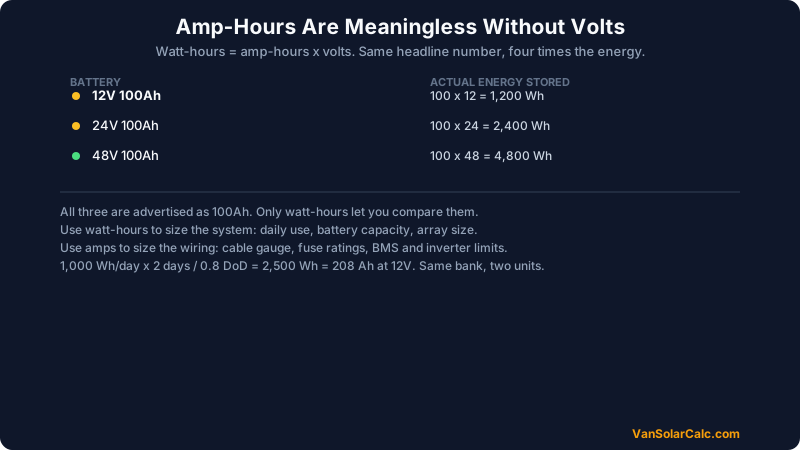
Battery listings advertise amp-hours. Solar panels are sold in watts. Your appliances are rated in watts. Somewhere in the middle, a lot of van builds go wrong, because amp-hours and watt-hours are not interchangeable and only one of them lets you compare anything.
The one formula
Watt-hours = amp-hours × volts
A 100Ah battery at 12V holds 100 × 12 = 1,200 Wh.
That is the whole conversion. The important part is what it implies.
Amp-hours are meaningless without a voltage
This is the trap. Two batteries both labelled "100Ah" can hold completely different amounts of energy:
| Battery | Amp-hours | Volts | Watt-hours |
|---|---|---|---|
| 12V 100Ah | 100 Ah | 12 V | 1,200 Wh |
| 24V 100Ah | 100 Ah | 24 V | 2,400 Wh |
| 48V 100Ah | 100 Ah | 48 V | 4,800 Wh |
Same headline number, four times the energy from first to last. An amp-hour figure quoted without a voltage tells you nothing, which is worth remembering when comparing products or reading forum advice.
Watt-hours are the honest unit. They let you compare a 12V bank against a 24V bank, a battery against a portable power station, and your consumption against your generation, all in the same currency.
Why van builds mix the two
Both units survive because each is convenient somewhere.
Amps matter for the physical stuff: wire gauge, fuse ratings and BMS limits are all current-based. A 2000 W inverter at 12V pulls about 185 A, and that number sizes your cable regardless of watt-hours. See what size inverter do I need.
Watt-hours matter for the energy budget: how much you use in a day, how much your panels make, how big a bank needs to be.
The rule of thumb: use watt-hours to size the system, amps to size the wiring.
Working an example both ways
Say your van uses 1,000 Wh a day and you want two days of reserve on 12V LiFePO4 at 0.8 depth of discharge.
In watt-hours: 1,000 × 2 = 2,000 Wh needed, divided by 0.8 = 2,500 Wh of nameplate battery.
In amp-hours: 2,500 Wh ÷ 12 V = 208 Ah.
Both describe the same bank. The watt-hour version is the one you can check against your solar array, because panels are rated in watts. The amp-hour version is the one you use to go shopping.
The full method is in what size battery do I need for a camper van.
Converting appliances
Appliances are usually rated in watts. To get watt-hours, multiply by hours of use:
| Appliance | Watts | Hours | Watt-hours | Amp-hours at 12V |
|---|---|---|---|---|
| 12V fridge | 45 W | 10 (cycling) | 450 Wh | 37.5 Ah |
| Roof fan | 25 W | 8 | 200 Wh | 16.7 Ah |
| LED lights | 15 W | 4 | 60 Wh | 5 Ah |
| Laptop | 65 W | 4 | 260 Wh | 21.7 Ah |
| Starlink | 50 W | 6 | 300 Wh | 25 Ah |
Total: 1,270 Wh, or about 106 Ah a day at 12V.
One caution on AC appliances. Anything running through an inverter costs more from the battery than its nameplate suggests, because the inverter is roughly 90 percent efficient. A 1,000 W kettle for six minutes is 100 Wh of work but about 111 Wh out of the bank.
Rather than doing this by hand, the van solar calculator takes your appliance list and returns both units, along with the array, controller, cable and fuse. The manual method is in how to calculate your van's daily power usage.
FAQ
What is the difference between amp hours and watt hours?
Amp-hours measure charge and watt-hours measure energy. Watt-hours equal amp-hours multiplied by voltage, so a 12V 100Ah battery holds 1,200 Wh. Amp-hours only describe how much energy a battery stores if you also know its voltage, which is why watt-hours are the better unit for comparing systems.
How do I convert amp hours to watt hours?
Multiply amp-hours by the battery voltage. A 100Ah battery at 12V is 1,200 Wh, and the same 100Ah at 24V is 2,400 Wh. To go the other way, divide watt-hours by voltage.
Is a 24V 100Ah battery better than a 12V 100Ah battery?
It stores twice the energy, 2,400 Wh against 1,200 Wh, because energy depends on voltage as well as amp-hours. Whether it is better for your van is a separate question, since almost all van appliances are 12V and a 24V system needs a converter or 24V equipment.
Should I size my van system in amps or watts?
Use watt-hours for the energy budget, meaning daily consumption, battery capacity and solar array size, because that lets you compare generation against use. Use amps for the physical components, meaning wire gauge, fuse ratings and inverter current draw, because those are limited by current rather than energy.