What Size Charge Controller Do I Need? (MPPT Sizing)
By Frank Zale · August 4, 2026 · 4 min read
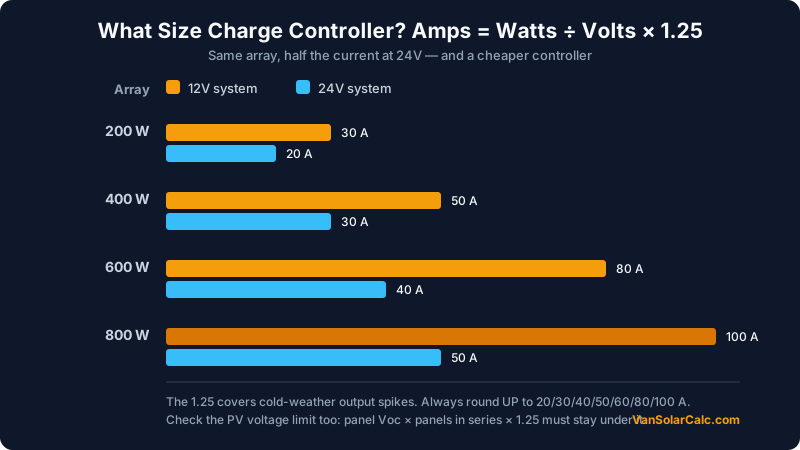
A solar charge controller sits between your panels and your battery. Undersize it and it will either limit your array or shut down on a bright cold day. Oversize it and you have wasted money but harmed nothing. The sizing rule takes about thirty seconds once you know it.
The formula
Controller amps = array watts ÷ battery voltage × 1.25
Then round up to the next standard size: 20, 30, 40, 50, 60, 80, or 100 A.
The 1.25 multiplier is not padding. Panels can briefly exceed their rated output when the cell temperature is low and the sun is strong — a clear, cold morning after snow is the classic case. Sizing exactly to the calculated amperage means the controller clips output or trips on precisely the days your panels perform best.
Worked examples
| Array | System voltage | Raw amps | × 1.25 | Controller |
|---|---|---|---|---|
| 200 W | 12V | 16.7 A | 20.8 A | 30 A |
| 400 W | 12V | 33.3 A | 41.7 A | 50 A |
| 600 W | 12V | 50.0 A | 62.5 A | 80 A |
| 400 W | 24V | 16.7 A | 20.8 A | 30 A |
| 800 W | 24V | 33.3 A | 41.7 A | 50 A |
Look at the last two rows. Moving from 12V to 24V roughly halves the current for the same array, which means a smaller, cheaper controller and thinner cable. If you are planning 600 W or more, 24V is worth serious thought before you buy anything.
Check the voltage limit too
Amperage is only half the specification. Every controller has a maximum PV input voltage, often 100V or 150V. Panels wired in series add their voltages together, and open-circuit voltage (Voc) rises as temperature drops.
Multiply the panel Voc by the number in series, then add roughly 25% cold margin:
Four panels at 22V Voc, in series: 4 × 22 = 88V, × 1.25 = 110V
That combination exceeds a 100V controller and needs a 150V unit. Exceeding the PV voltage limit does not trip a breaker — it destroys the controller, and it is not covered by warranty.
MPPT or PWM
| PWM | MPPT | |
|---|---|---|
| Efficiency | 70–80% | 93–98% |
| Panels in series | No | Yes |
| Cost | Low | Higher |
| Best for | Small 12V arrays | Almost everything else |
A PWM controller drags panel voltage down to battery voltage and loses the difference as heat. An MPPT controller converts the excess voltage into usable current, which is where the extra 15–25% comes from.
On a 400 W array that difference is roughly 200–300 Wh a day, about what a compressor fridge uses. MPPT pays for itself on anything above a small maintenance panel. The full comparison is in our post on MPPT vs PWM controllers.
Sizing for the future
Controllers are sized to the array, so if you plan to add panels later, size for the final array now. Going from 400 W to 600 W later means replacing a 50 A controller with an 80 A one — cheaper to buy the 80 A once.
The reverse is also true: an oversized controller runs a small array perfectly well. There is no efficiency penalty for headroom.
Do not forget the fuses
A charge controller needs protection on both sides. Fuse the PV input to the controller's rated input current, and fuse the controller-to-battery run to the controller's output rating. The battery-side fuse belongs within a few inches of the battery terminal, because that cable is live whenever the battery is connected.
Cable gauge matters here too. Our wire size calculator covers the method — ABYC ampacity plus a 3% voltage-drop check over the round-trip length, with the thicker of the two answers winning.
FAQ
What size charge controller do I need for 400W?
At 12V, 400 W needs 400 ÷ 12 × 1.25 = 41.7 A, so a 50 A MPPT controller. At 24V the same array needs only about 21 A, so a 30 A controller.
What happens if my charge controller is too small?
A quality MPPT controller will current-limit, capping output at its rating and wasting the surplus. Cheaper units may overheat or shut down. Neither damages the battery, but you lose the power you paid for on your best solar days.
Can a charge controller be too big?
No. An oversized controller simply operates below its maximum. The only cost is the purchase price, and it leaves room to add panels later.
Do I need a charge controller for a small panel?
Yes, for anything above roughly 5 W. Without one, a panel keeps pushing current into a full battery and will overcharge it. Only very small maintenance panels are safe unregulated.
Size your controller alongside the rest of the system with the free solar calculator, or read the dedicated MPPT sizing page for more worked examples.