Solar Panels for Van Life: How Many Watts You Actually Need
By Frank Zale · August 4, 2026 · 5 min read
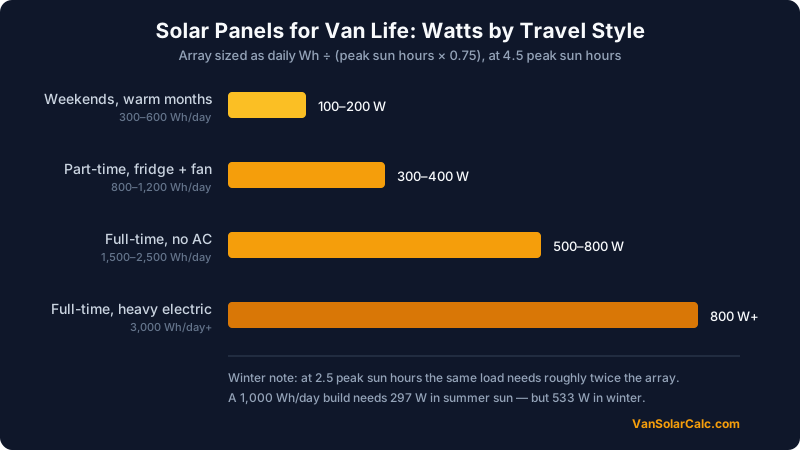
Most guides answer "how many solar panels for van life?" with a number pulled from someone else's build. That number is useless to you, because panels do not power your van — watt-hours do. Two vans with identical 400 W arrays can have completely different outcomes if one runs a compressor fridge and the other runs a fridge, a diesel heater, and Starlink.
This guide gives you the actual method, then the realistic watt ranges for each style of travel.
What solar panels really do
A solar panel is rated in watts, but what matters is watt-hours per day — watts multiplied by usable sun. A 200 W panel does not make 200 W all day. It makes close to its rating for a few hours around midday and much less either side.
The industry shorthand for that is peak sun hours: the number of hours per day equivalent to full-strength sun. Most of the US averages 4 to 5 peak sun hours annually. The Pacific Northwest in December is closer to 1.5.
There is also loss in the system — wiring resistance, controller efficiency, heat, panel angle, dust. This site applies a 0.75 derate, which is the honest real-world figure:
Daily watt-hours = panel watts × peak sun hours × 0.75
A 400 W array at 4.5 peak sun hours produces about 1,350 Wh a day, not 1,800.
The only calculation that matters
Work backwards from what you use. List every device, its watts, and hours per day.
| Device | Watts | Hours/day | Wh/day |
|---|---|---|---|
| 12V compressor fridge | 45 | 10 | 450 |
| Roof fan | 25 | 8 | 200 |
| LED lights | 15 | 4 | 60 |
| Laptop | 65 | 4 | 260 |
| Phone charging | 10 | 3 | 30 |
| Total | 1,000 Wh |
Now flip the formula:
Panel watts = daily Wh ÷ (peak sun hours × 0.75)
At 4.5 peak sun hours: 1,000 ÷ (4.5 × 0.75) = 297 W. Round up to 300–400 W.
Note what happens in winter. At 2.5 peak sun hours the same 1,000 Wh needs 1,000 ÷ (2.5 × 0.75) = 533 W. Sizing on the annual average is why so many builds run out of power in November.
Anything running through an inverter costs more than its label, because inverters are about 90% efficient. A 65 W laptop on AC pulls roughly 72 W from the battery. Run 12V wherever you can.
Realistic watt ranges
| Style of travel | Typical daily load | Array | Battery (LiFePO4) |
|---|---|---|---|
| Weekends, warm months | 300–600 Wh | 100–200 W | 50–100 Ah |
| Part-time, fridge + fan | 800–1,200 Wh | 300–400 W | 100–200 Ah |
| Full-time, no AC | 1,500–2,500 Wh | 500–800 W | 200–300 Ah |
| Full-time, heavy electric | 3,000 Wh+ | 800–1,200 W | 400 Ah+ |
Roof space is usually the real limit before budget is. A Sprinter 144 fits roughly 400–600 W once a fan and vents are placed. If your number lands above what your roof holds, the answer is to cut load, not to buy thinner panels.
Panel types
| Type | Efficiency | Lifespan | Best for |
|---|---|---|---|
| Rigid monocrystalline | Highest | 20–25 yrs | Almost every build |
| Flexible | Lower | 5–8 yrs | Curved roofs, weight limits |
| Portable folding | Good | 10+ yrs | Parking in shade, supplementing |
Rigid monocrystalline wins for most people. Flexible panels glued to a roof run hot, which cuts output further, and they fail years sooner. Their real use case is a roof that genuinely cannot take brackets.
Portable panels solve a problem fixed arrays cannot: you park in shade and put the panel in sun. Many full-timers run a fixed array plus one folding panel.
Series or parallel
Once you have more than one panel, wiring changes the voltage and current your controller sees. Series adds voltage and suits long cable runs and MPPT controllers; parallel keeps voltage low and handles partial shade better. The full trade-off is in our guide on wiring panels in series vs parallel.
What else you need
Panels are roughly a quarter of the system. You also need a charge controller sized at array watts ÷ system volts × 1.25, a battery bank sized to your daily load and days of autonomy, correctly gauged cable, and a fuse on every positive run. Our component sizing pages cover each one.
Common mistakes
Sizing panels before measuring load. The load number drives everything else.
Using the annual sun average for winter travel. Size for the worst month you will actually travel in.
Forgetting the battery. Panels only charge during daylight. The battery is what carries you overnight and through cloudy days.
Skipping a second charging source. A DC-DC charger from the alternator turns driving into charging and covers stretches where solar cannot keep up.
FAQ
How many solar panels do I need for van life?
Most van builds land between 300 W and 600 W, which is two to three panels. The correct figure comes from your daily watt-hours divided by peak sun hours times 0.75. A 1,000 Wh/day build at 4.5 peak sun hours needs about 300 W.
Can 200W of solar run a van?
It can run a modest setup (a compressor fridge, a fan, lights, and phone charging) in good sun, producing roughly 675 Wh a day at 4.5 peak sun hours. It is not enough for full-time use with a laptop, Starlink, or winter travel.
Do solar panels work on cloudy days?
Yes, but at roughly 10–25% of rated output. This is why battery capacity matters as much as panel watts. Two days of autonomy in your battery bank covers a typical cloudy stretch.
Is 400W of solar enough for full-time van life?
For a full-timer without air conditioning or electric cooking, 400 W paired with 200 Ah of LiFePO4 is a workable setup in spring through autumn. Year-round travel in northern latitudes usually needs 600 W or more, or a DC-DC charger to fill the winter gap.
Size your own system with the free solar calculator — enter your appliances and location and it works out panels, battery, controller, wire, and fuses, with a cost estimate.