Wiring Van Batteries in Parallel vs Series
By Frank Zale · August 30, 2026 · 5 min read
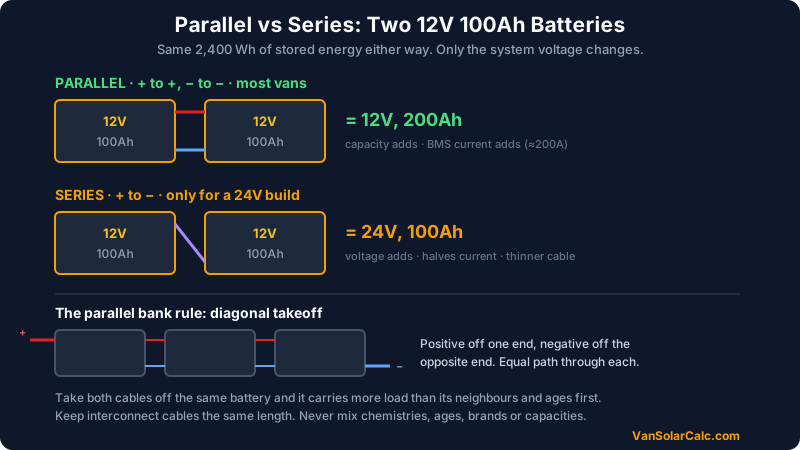
Two 100Ah batteries can give you 200Ah at 12V or 100Ah at 24V. Same batteries, same cables, completely different system. The difference is which terminals you join, and getting it backwards is one of the few van wiring mistakes that damages hardware immediately.
The two arrangements
Parallel joins positive to positive and negative to negative. Voltage stays the same, capacity adds.
Two 12V 100Ah batteries in parallel give 12V, 200Ah.
Series joins the positive of one battery to the negative of the next. Voltage adds, capacity stays the same.
Two 12V 100Ah batteries in series give 24V, 100Ah.
| Parallel | Series | |
|---|---|---|
| Voltage | Unchanged | Adds |
| Capacity (Ah) | Adds | Unchanged |
| Total energy (Wh) | Same either way | Same either way |
| Current draw | Higher | Halved at 24V |
| Cable size needed | Thicker | Thinner |
Total stored energy is identical. Two 12V 100Ah batteries hold 2,400 Wh whichever way you wire them. What changes is the voltage the system runs at, and therefore the current everything else has to carry.
For most vans, parallel
If you are building a 12V system, which nearly every van is, you wire batteries in parallel. Everything else in a van is 12V: the fridge, the fan, the lights, the water pump, the USB sockets. Going to 24V means either replacing all of that or adding a converter.
Series is the right answer only when you have deliberately chosen a 24V system, usually because a large inverter would otherwise demand impractical current. A 3000 W inverter pulls about 278 A at 12V and roughly 139 A at 24V, and that halving is the entire argument. See what size inverter do I need.
Parallel banks fail in a specific way
Wired carelessly, a parallel bank does not fail loudly. It just ages unevenly, and one battery does more work than the others until it degrades first.
The cause is resistance. If the load cable connects to the positive and negative of the same battery, that battery sits electrically closer to the load and supplies more current than its neighbours.
The fix is diagonal takeoff. Draw the positive from one end of the bank and the negative from the opposite end. Current then has an equal path length through every battery.
The second rule is equal cable lengths between batteries. If one interconnect is 200 mm and another is 500 mm, the batteries do not share load evenly no matter how you take off. Cut them to matching lengths even when it means a slightly longer run.
BMS current adds too
This is worth knowing if you run a large inverter.
Each LiFePO4 battery has a BMS with a continuous discharge limit, commonly 100 A on a 100Ah unit. In parallel, those limits add. Two 100Ah batteries give roughly 200 A of continuous capability, which is what makes a 2000 W inverter workable where a single battery would cut out.
This is the practical argument for two 100Ah batteries over one 200Ah unit. A single 200Ah battery often has a 100 A or 150 A BMS, so it stores the same energy but cannot deliver it as fast. Check the datasheet rather than assuming capacity implies current.
Rules for building a bank
- Do not mix chemistries. Never put LiFePO4 in parallel with lead-acid. Their charge voltages and internal resistance differ enough that one will constantly try to charge the other.
- Do not mix ages. An old battery drags a new one down to its condition.
- Do not mix capacities or brands. Different internal resistance means unequal sharing.
- Fuse each battery. A short in one battery or its cable should not be fed by the entire bank.
- Match cable lengths and use diagonal takeoff.
Charge them as one bank with one controller. Chemistry-correct charge settings matter more than the wiring topology, and they are covered in LiFePO4 charge settings.
For working out how much capacity you need in the first place, see what size battery do I need for a camper van, or run your appliances through the van solar calculator, which sizes the bank, cable and fuse together.
FAQ
Should I wire camper van batteries in series or parallel?
Parallel, for almost every van. A van runs on 12V and parallel wiring keeps the bank at 12V while adding capacity, so two 100Ah batteries become 200Ah. Series doubles voltage to 24V and only makes sense if you have deliberately built a 24V system to reduce current for a large inverter.
Does wiring batteries in parallel increase voltage?
No. Parallel wiring keeps voltage the same and adds capacity in amp-hours. Series wiring adds voltage and leaves capacity unchanged. Total stored energy in watt-hours is the same either way, so the choice is about what voltage your appliances expect.
Can I mix old and new batteries in parallel?
You should not. Batteries in parallel share load according to their internal resistance, so an older, higher-resistance battery pushes work onto the newer one and pulls the whole bank toward its own condition. The same applies to mixing capacities, brands or chemistries.
How do I balance batteries wired in parallel?
Use diagonal takeoff, drawing the positive from one end of the bank and the negative from the opposite end, so current travels an equal path through each battery. Keep all interconnecting cables the same length and gauge. Without both, the battery nearest the load does more work and ages first.