Monocrystalline vs Polycrystalline vs Flexible Panels for Vans
By Frank Zale · August 30, 2026 · 5 min read
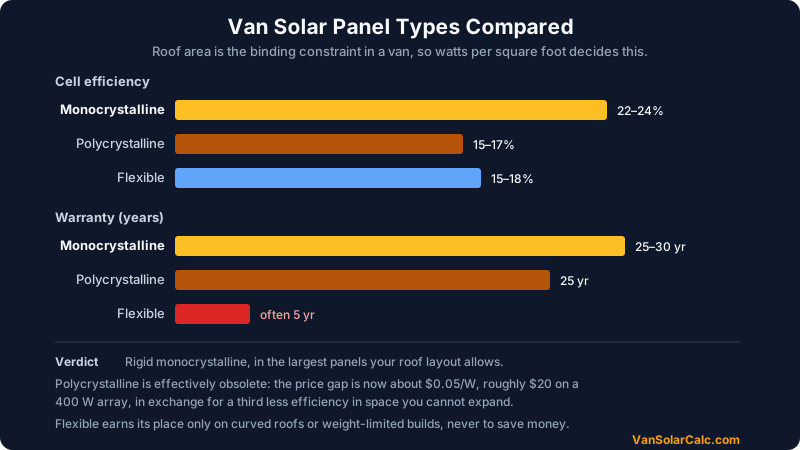
The panel choice for a van used to be a real decision. In 2026 it mostly is not. Monocrystalline has won on efficiency, on price, and on warranty, and the only genuine question left is whether your roof forces you into flexible panels despite their drawbacks.
Here is where each type actually stands.
The three types
| Monocrystalline | Polycrystalline | Flexible | |
|---|---|---|---|
| Efficiency | 22–24% | 15–17% | 15–18% |
| Watts per sq ft | ~19–21 W | ~15–17 W | ~15–17 W |
| Warranty | 25–30 years | 25 years | Often 5 years |
| Weight | Heavy (glass + frame) | Heavy | Very light |
| Cost per watt | Lowest overall | Marginally cheaper | Higher per usable watt |
| Curved roof | No | No | Yes |
Polycrystalline is effectively obsolete
Poly panels existed because they were cheaper to manufacture. That was the entire argument, and it has gone.
The price gap between mono and poly is now around $0.05 per watt. On a 400 W van array that is $20. In exchange for that $20 you would give up roughly a third of the efficiency, which on a van roof translates directly into fewer watts in the space you have.
Roof area is the binding constraint in a van build, not panel price. Paying $20 to avoid losing a quarter of your array capacity is not a close call. If you see a cheap poly panel, the saving is not worth the roof space.
Monocrystalline is the default
Mono gives you the most watts per square foot, which matters more in a van than almost anywhere else. A Sprinter 144 has 55 to 70 sq ft of usable roof after a fan and vents. At mono efficiency that is 400 to 600 W. At poly efficiency the same roof gives you noticeably less, and you cannot buy more roof.
It also has the longest warranties, 25 to 30 years, and the lowest degradation rates.
The trade-off is weight. A rigid mono panel carries glass and an aluminium frame, so a 200 W panel runs around 25 to 30 lb. For most vans this is fine. For a high-top with a marginal roof load rating, or a build already close to its weight limit, it is worth checking.
Roof space by vehicle is covered in how many solar panels fit on a van roof.
Flexible panels: one good reason, several costs
Flexible panels are thin, light, and bond directly to a curved surface. That is a real advantage on a rounded high-top, a fibreglass roof, or a build where every pound counts.
The costs are significant and worth being honest about:
Shorter life. Many flexible panels carry a five year warranty against 25 for rigid. Some fail well before that.
Heat. Bonded flat to the roof with no air gap, they run hotter than a framed panel on brackets. Panels lose output as they heat, so a flexible panel installed the usual way gives up power exactly when the sun is strongest.
Lower efficiency. Around 15 to 18 percent, so fewer watts from the same area.
They are not repairable. A glued panel that fails is a difficult removal, and it often takes roof coating with it.
Choose flexible when the roof shape or a weight limit genuinely rules out rigid. Do not choose it to save money, because per usable watt-year it is the expensive option. The mounting trade-offs are covered in how to mount solar panels on a van.
What to actually buy
Rigid monocrystalline, in the largest panels that fit your roof layout, unless a curved roof or a weight limit forces otherwise. Fewer, larger panels mean fewer brackets, fewer roof penetrations and fewer MC4 connections to fail.
Then check the datasheet rather than the marketing. Voc, Isc and the temperature coefficients determine whether your string is safe with your controller, and cell type tells you nothing about that. See solar panel specs explained.
Work out the array size you need first, from your actual daily consumption, using the van solar calculator.
FAQ
Is monocrystalline or polycrystalline better for a van?
Monocrystalline, clearly. It reaches 22 to 24 percent efficiency against 15 to 17 percent for polycrystalline, so it produces meaningfully more power from the limited roof space a van has. The old price advantage of poly has narrowed to roughly $0.05 per watt, which is about $20 on a typical van array and not worth the lost capacity.
Are flexible solar panels good for a camper van?
They are the right choice for curved roofs and weight-limited builds, and a poor choice otherwise. Flexible panels are lighter and conform to shaped surfaces, but they are less efficient, often carry a five year warranty against 25 for rigid, and run hotter because they sit flat against the roof with no air gap.
How long do van solar panels last?
Rigid monocrystalline panels are warranted for 25 to 30 years and commonly outlast the van. Flexible panels are the exception, with warranties often around five years and a shorter practical life, particularly when bonded flat to a hot roof.
Do flexible solar panels produce less power?
Yes, for two reasons. Their cell efficiency is lower, typically 15 to 18 percent against 22 to 24 percent for monocrystalline, so they generate less from the same area. They also run hotter because they mount flush without an air gap, and panel output falls as temperature rises.