12V vs 24V for a Camper Van: Which Should You Build?
By Frank Zale · September 11, 2026 · 5 min read
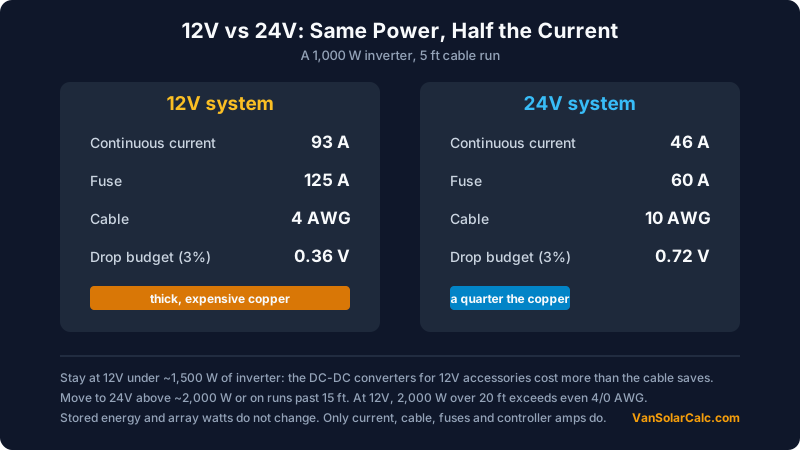
Almost every camper van is built at 12V, mostly because that is what the vehicle already runs and what the accessories are sold for. For a lot of builds that is the right answer. But if your system is getting large, sticking with 12V quietly doubles the cost of your copper and pushes you into cable sizes that are genuinely awkward to work with.
Here is how to decide, with the numbers rather than opinions.
What changes when you double the voltage
Power is volts times amps. Double the voltage and you halve the current for the same power. That single fact drives everything else.
| 12V | 24V | |
|---|---|---|
| 1,000 W inverter draws | 93 A | 46 A |
| Fuse for that inverter | 125 A | 60 A |
| Cable at a 5 ft run | 4 AWG | 10 AWG |
| 400 W array needs | 50 A controller | 30 A controller |
| 3% voltage drop budget | 0.36 V | 0.72 V |
Look at the cable row. Going from 4 AWG to 10 AWG is not a small saving. It is roughly a quarter of the copper, it is far easier to route and terminate, and the lugs and crimping tools are cheaper too.
The voltage drop row is the one people miss. A 3% budget is a percentage of system voltage, so at 24V you have twice as many volts to spend, while carrying half the current to begin with. Those two effects compound.
When 12V is the right choice
Most weekend and part-time builds. If your daily use is under about 1,200 Wh and your largest AC load is a kettle, the cable savings do not pay for the added complexity.
When you run a lot of native 12V gear. Fridges, fans, water pumps, lights, USB sockets and Starlink accessories are overwhelmingly 12V. On a 24V system every one of these needs a step-down converter, which costs money, takes space, and adds another thing that can fail.
When you want simplicity. A 12V system matches the vehicle. You can jump from the starter battery, run a DC-DC charger without conversion, and any auto electrician understands it.
When 24V starts to win
Inverters above about 2,000 W. At 12V a 2,000 W inverter pulls roughly 185 A continuously and needs a 250 A fuse. Cable for that is 1/0 AWG at short runs and thicker as the distance grows. At 24V the same inverter pulls 93 A, which is ordinary 4 AWG territory.
Long cable runs. This is the decisive one. A 2,000 W inverter 20 ft from the battery at 12V needs more than 4/0 AWG to stay inside a 3% drop, which is to say no single standard cable will do it. The same run at 24V is straightforward.
Arrays above roughly 600 W. Controller amperage halves, so you stay inside affordable controller sizes rather than needing a 100 A unit or two controllers.
Air conditioning or induction cooking. Both are large, sustained loads, and both are far more comfortable at 24V.
The honest cost of switching
24V is not free. Be clear about what it costs:
- DC-DC converters for every 12V accessory, or 24V versions where they exist. Budget for this properly, because it is the part people forget.
- Charging from the alternator needs a 12V to 24V DC-DC charger rather than a simple one. They exist and work well, but they cost more.
- Fewer off-the-shelf parts. The camper accessory market is built around 12V. You will have less choice and pay slightly more.
- Batteries in series. Two 12V batteries in series make 24V, but they must be matched and are best managed as a pair.
A simple decision rule
Work out your largest simultaneous AC load and your longest cable run, then:
- Under 1,500 W of inverter and runs under 10 ft: stay at 12V. The savings will not justify the converters.
- 2,000 W or more, or any run past 15 ft: seriously price 24V. Compare the cost of converters against the cost of the cable, fuses and lugs you would otherwise buy.
- Above 3,000 W: 24V or 48V, effectively without exception. At 12V the currents stop being practical.
Run both scenarios through the wire size calculator with your real numbers. Switch the voltage selector and watch the cable size change. That comparison usually settles the argument faster than any article.
What does not change
Your daily watt-hours do not change with system voltage, and neither does the energy your battery stores. A 200 Ah 12V bank and a 100 Ah 24V bank both hold about 2,400 Wh. Amp-hours are simply energy divided by voltage, which is why comparing banks in amp-hours across different voltages is meaningless. Compare watt-hours.
Solar array size does not change either. A 1,000 Wh daily load needs the same watts of panel at either voltage. Only the controller amperage differs.
FAQ
Is 24V better than 12V for a camper van?
Not universally. 24V halves the current for the same power, which makes cable, fuses and controllers cheaper and easier, so it wins on larger systems. But it needs converters for the 12V accessories that dominate the camper market. Under roughly 1,500 W of inverter, 12V is usually the simpler and cheaper choice.
Can I mix 12V and 24V in the same van?
Yes, and most 24V builds do exactly that. The battery bank and inverter run at 24V, and a DC-DC converter feeds a 12V distribution panel for the fridge, fan, lights and sockets. Size that converter for the total 12V load, not the average.
Does 24V give me more power?
No. It gives you the same power at half the current. The benefit is entirely in the wiring, the fuses and the controller sizing, not in the energy available to you.
Do I need special solar panels for 24V?
No. Panels are wired to suit the controller's input, not the battery voltage. An MPPT controller converts whatever the array delivers down to what the battery needs, so the same panels work for either system.
Compare both voltages with your own figures using the wire size calculator and the MPPT calculator, or size the whole build at once with the full calculator.