Van Solar for Beginners: Where to Start
By Frank Zale · August 25, 2026 · 2 min read
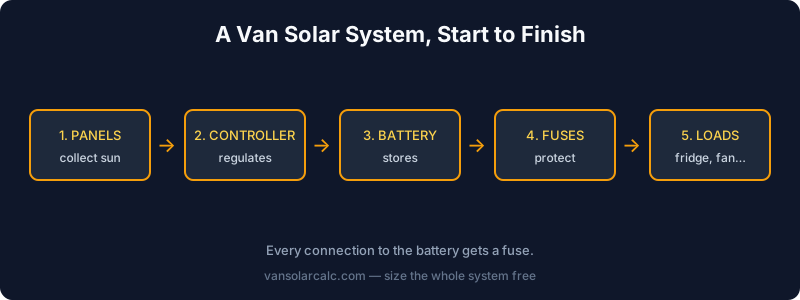
New to van solar? Here's the whole thing in one sentence: solar panels charge a battery through a charge controller, and your fridge, lights, and gadgets run off that battery. That's it. This guide gets you from zero to a plan without the jargon.
The 5 parts you need
- Solar panels — sit on the roof and turn sunlight into power.
- Charge controller (MPPT) — the brain; charges the battery safely.
- Battery — stores the power for night and cloudy days.
- Fuses & wiring — keep everything safe.
- Loads — your fridge, fan, lights, and chargers.
Optional but common: an inverter (for household AC appliances) and a DC-DC charger (charges the battery while you drive).
The order everything connects
Panels → charge controller → battery → fuse block → your 12V stuff. The inverter, if you have one, wires straight to the battery. Every wire touching the battery gets a fuse. See the full wiring walkthrough.
How to size it (the easy way)
- List your appliances and how many hours a day you use each.
- Add up the watt-hours (watts × hours). That number drives everything — here's how.
- Battery ≈ daily watt-hours × 2 days.
- Solar ≈ daily watt-hours ÷ 4 (rough, good-sun).
Or skip the math entirely: the free calculator turns your appliance list into a full parts list in two minutes.
Beginner mistakes to avoid
- Buying the battery too small — it's the #1 regret. Go bigger than you think.
- Skipping fuses — never. They prevent fires.
- Cheap thin wire — undersized wire overheats. Use the right gauge.
- Ignoring winter — sun output roughly halves in winter.
What it costs
A simple weekender system starts around $1,000–1,800; see the full cost breakdown or a budget build under $1,000.
FAQ
What do I need for a basic van solar setup?
Solar panels, a charge controller, a battery, fuses and wiring, plus your 12V appliances. Add an inverter only if you need household AC power.
How much solar does a beginner van need?
Most start with 200W of solar and a 100Ah battery for a fridge, fan, lights, and phones. Add more for a laptop, Starlink, or full-time living.
Do I need an electrician?
The 12V side is beginner-friendly if you follow a wiring plan and fuse everything. Get the AC/shore-power side checked if you're unsure.